

Starting soccer as an adult can feel intimidating, especially when other players seem to know exactly where to pass, when to move and how to finish. But you don’t need years of experience to start building those skills. You need clear instructions, regular practice and opportunities to learn without feeling rushed.
Passing and shooting are closely connected. An accurate pass helps a teammate control the ball, while a well-timed supporting run can turn a simple exchange into a scoring opportunity. Practicing these actions together helps you understand what to do after passing, rather than standing still and watching the play.
The two drills below give adult beginners a practical way to develop that confidence. Start with a paired exercise to practice accurate passes, forward runs and controlled finishes. Then put those skills into a small-sided game where you learn to find space and choose an open goal. Keep the pace comfortable, focus on accuracy and use the easier variations whenever you need them.
Drill 1: Pass Back, Run Forward
PURPOSE: Develop accurate short passing and the timing of a forward run after releasing the ball. Players learn to pass into a teammate’s path and turn that combination into a controlled finish. Working in pairs gives both players repeated involvement without a shooting queue.
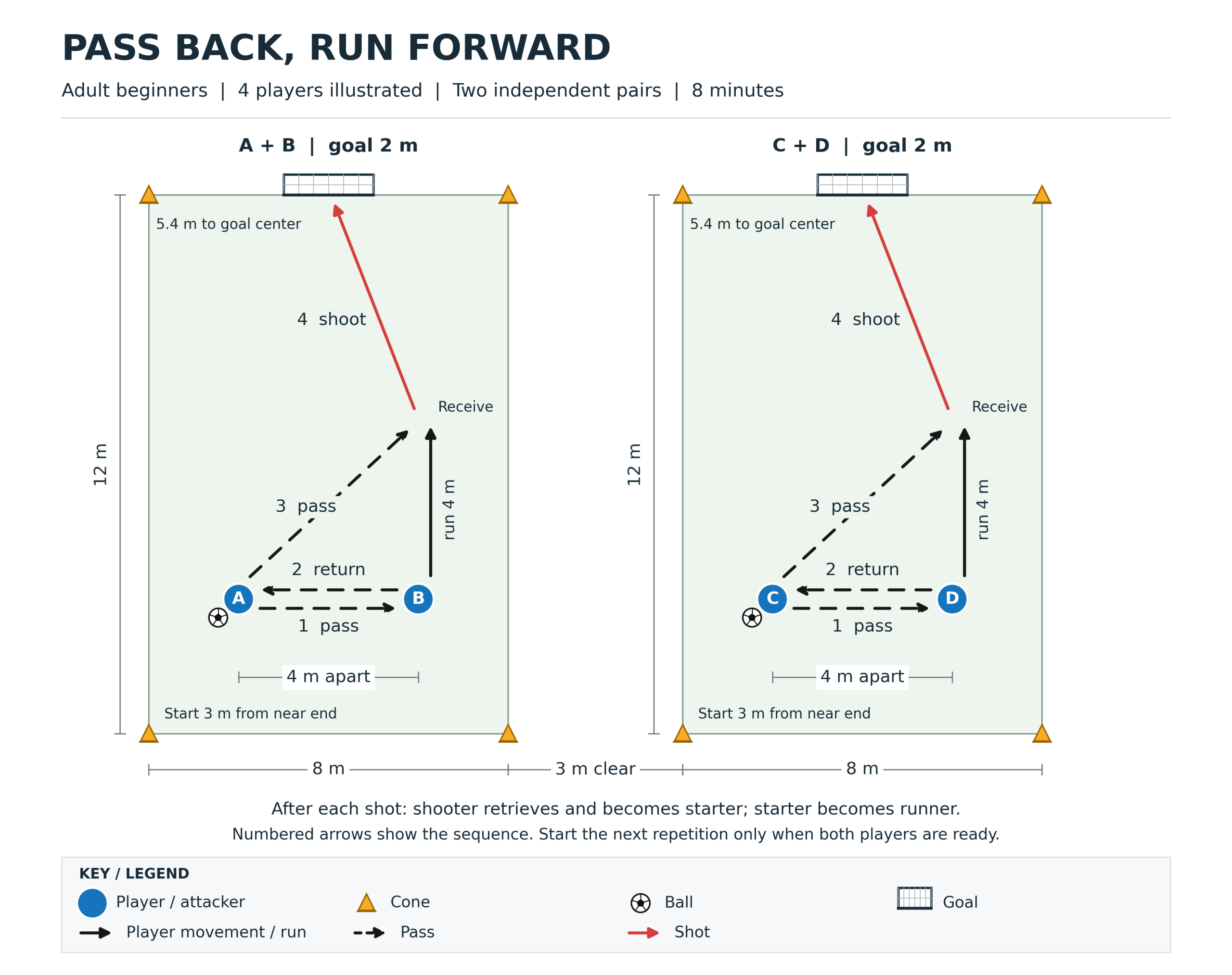
PLAYERS: Four illustrated: A and B in the left lane, C and D in the right.
- 6–8 players: Use three or four paired lanes.
- 5 or 7 players: Make one group a trio, using the rotation below.
- 8–12 players: Use four to six paired lanes. With an odd number, make one group a trio.
DURATION: Eight minutes: one-minute demonstration, three minutes of practice, one-minute recovery and feedback, then three more minutes of practice.
EQUIPMENT: Eight boundary cones, two size-5 balls and two secured mini-goals, each 2 m wide. Each additional lane needs four cones, one ball and one goal. No goalkeepers.
AREA: Each lane measures 12 m long × 8 m wide. Leave a 3 m clear corridor between lanes and at least 3 m of clear runoff behind the goals. The illustrated setup occupies 19 m × 12 m, excluding runoff.
SKILLS DEVELOPED: Ground passing, receiving, timed forward runs and accurate shooting.
SETUP:
- Mark each lane with one cone at each corner. Center a goal on the far end line.
- A starts 3 m from the near end and 2 m from the left sideline, with the ball.
- B starts level with A, 2 m from the right sideline. The players are 4 m apart.
- C and D take identical positions in the other lane, with C on the ball.
- The forward receiving point is 4 m directly ahead of B/D, approximately 5.4 m from the goal’s center. This is a reference point, not an additional cone.
- Keep the corridor clear. Pause the neighboring lane before retrieving a stray ball from it.
HOW TO RUN THE DRILL:
- Pass across: A passes along the ground to B. B controls the ball and passes it back to A. Allow settling touches.
- Pass, then run: Immediately after returning the ball, B jogs 4 m straight forward. A stays in the starting position and controls the return.
- Find the runner: A looks up and delivers a diagonal ground pass toward the receiving point, timed to meet B’s arrival. B may slow or stop there if necessary.
- Receive and finish: B receives toward the goal and takes a controlled, low shot. Allow an extra settling touch. The diagonal pass travels about 5.7 m; the shot is roughly 5 m after the first touch.
- Swap roles: After shooting, B retrieves the ball and carries it to A’s original position. A walks to B’s original position. B now starts the sequence, and A becomes the runner and shooter.
- Keep both lanes active: C and D follow the same sequence independently. Begin the next repetition only when both players are ready.
- Trio rotation: The third player waits 1 m behind the near end line. After each shot, the waiting player becomes the starter, the starter becomes the runner, and the shooter retrieves the ball, hands it to the new starter and becomes the waiting player.
- Scoring and restarts: Award one point for a goal following all three completed passes. If a pass leaves the lane, retrieve it and restart with the same roles.
- Coach’s resets: Stop immediately if a person or stray ball enters a shooting lane. Otherwise, coach individually and use the scheduled break to correct one shared problem.
COACHING POINTS:
- Plant the non-kicking foot beside the ball and use the inside of the foot with a firm ankle.
- Pass firmly enough to reach the receiver without making them stretch or chase.
- The runner must release the return pass before moving forward: “Pass, then move.”
- Before the diagonal pass, look up and aim into the runner’s path, not behind them.
- Receive partly turned toward the goal, keeping the first touch within one comfortable step.
- Finish with a controlled inside-foot strike toward the goal’s center rather than trying to generate maximum power.
PROGRESSION: Add a defender between the goal and the two players (starting about 3 m from goal). Keep the same distances and rotation.
EASIER VARIATION: Move the starter 1 m inward to reduce the first passing distance to 3 m. Let the runner reach the forward point and stop before receiving the diagonal pass. Allow unlimited settling touches.
COMMON MISTAKES:
- Running before completing the return pass: Rehearse “pass, then move” at walking speed.
- Passing behind the runner: Ask the starter to look up and aim at the forward receiving point.
- Taking a heavy first touch: Reduce pass speed and encourage the receiver to soften the foot on contact.
- Restarting before the partner is ready: Require both players to call “ready” after changing positions.
MATCH CONNECTION: This rehearses passing to a teammate, moving beyond the original passing line and receiving a forward ball to finish an attack.
DRILL 2: Pass and Pick a Goal
PURPOSE: Help beginners recognize when a pass creates a better shooting opportunity. Two available targets encourage players to spread out, support the ball carrier and notice an unguarded goal. Live opponents introduce simple decisions while keeping every player involved.
AGE GROUP: Adults aged 18+; beginner base, intermediate progression.
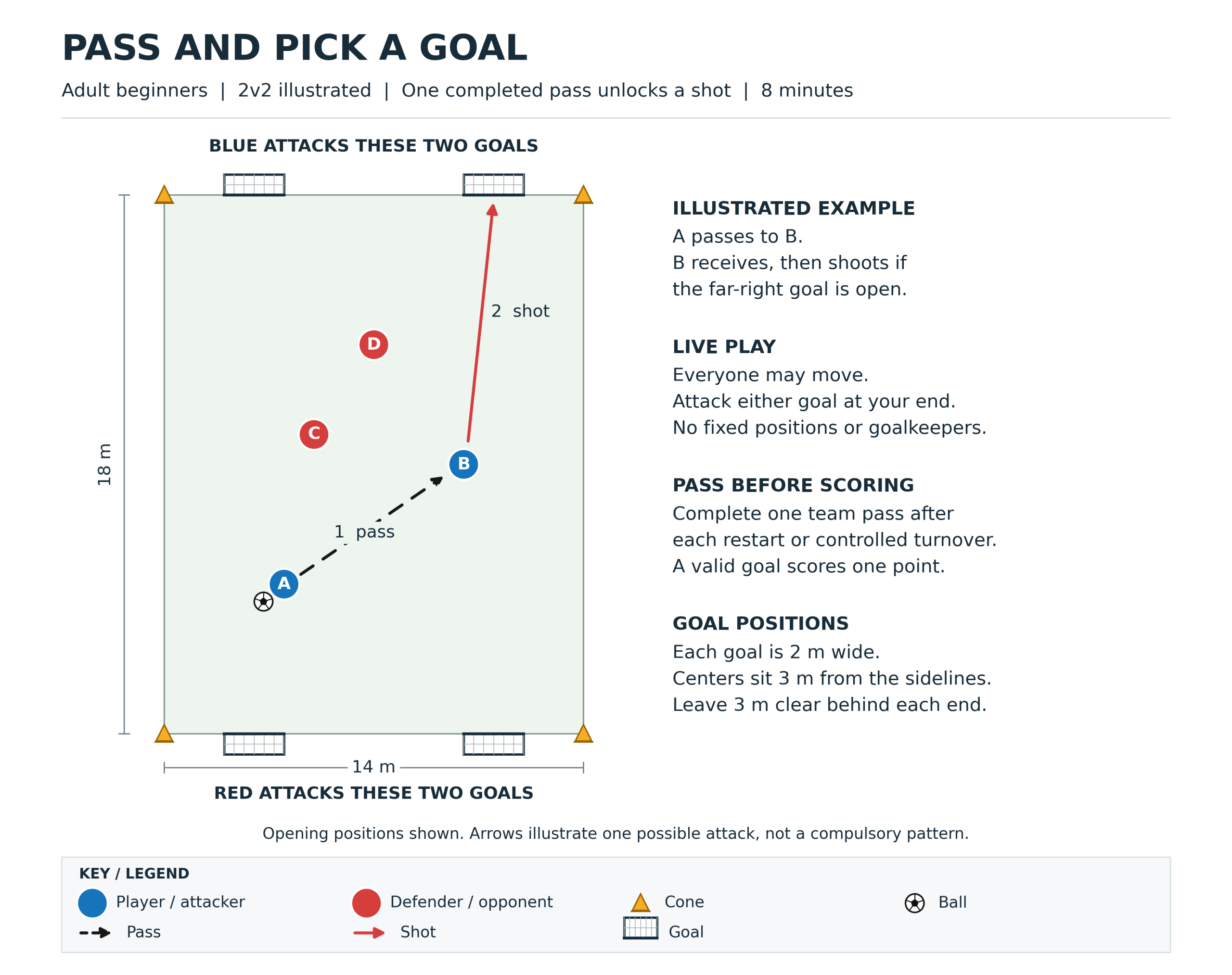
PLAYERS: Four illustrated: blue A and B against red C and D.
- 5 players: Play 2v2 with a neutral supporting the team in possession. The neutral cannot score; rotate this role every minute.
- 6 players: Play 3v3 on a 20 m × 16 m pitch.
- 7 players: Add a rotating neutral to the 3v3 game.
- 8 players: Use two separate 2v2 pitches.
- 9–12 players: Use two pitches with groups of four to six. Five means 2v2 plus a neutral; six means 3v3. Leave at least 4 m between pitches.
DURATION: Eight minutes: one-minute demonstration, three two-minute games and two 30-second recovery/coaching breaks between games.
EQUIPMENT: Four boundary cones, four secured mini-goals each 2 m wide, one size-5 ball and two bib colors. No goalkeepers.
AREA: 18 m long × 14 m wide, with at least 3 m of clear runoff behind both goal lines.
SKILLS DEVELOPED: Passing under pressure, supporting movement, first touch and shooting decisions.
SETUP:
- Place one cone at each corner.
- Position two goals on each 14 m end line. Each goal’s center sits 3 m from the nearest sideline, leaving a 6 m gap between the inner posts.
- Blue attacks the two far-end goals; red attacks the two near-end goals. Keep these directions throughout.
- For the illustrated opening, measure positions from the near-left corner: A starts 4 m across and 5 m forward, with the ball; B starts 10 m across and 9 m forward; C starts 5 m across and 10 m forward; D starts 7 m across and 13 m forward.
- These are starting positions only. After the opening pass, everyone moves freely.
HOW TO RUN THE DRILL:
- Start with a pass: A passes along the ground to B. Opponents remain at least 3 m from A until the ball is kicked. They may then press or intercept.
- Pass before scoring: The team in possession must complete at least one pass to a teammate before scoring in either attacking goal. A controlled reception completes a pass. Passes involving a neutral count.
- Support the receiver: After passing, move into a visible supporting position. Once the passing requirement is met, players may pass, dribble or shoot. There is no touch limit.
- Choose the open target: In the illustrated example, B receives and shoots toward the far-right goal if the lane remains open. This is one possible attack, not a compulsory pattern. If the lane closes, keep possession and find another angle.
- Defend and transition: Defenders try to intercept or win the ball while staying on their feet. No sliding tackles. After a controlled turnover, the new team must complete its own pass before scoring. A deflection alone does not reset the count.
- Score: Each valid goal earns one point. Shooting before completing a pass gives the opponents a restart beside the attempted goal. A shot entering the opponent’s goal ends that attack, even if it does not qualify as a score.
- Restart after a goal: The conceding team retrieves the ball and restarts from its end line between the goals. Opponents retreat 3 m. The restart pass counts if a teammate controls it.
- Restart after the ball goes out: The opponents of the last player to touch it restart with a ground pass from the exit point. Opponents retreat 3 m. Resume only when the retrieving player is back and ready.
- Share responsibilities: Teammates alternate taking restarts. Nobody stays permanently at the back or inside a goal. Start the next two-minute game with the other team in possession.
- Coach’s resets: Stop for unsafe contact, a displaced goal or another ball entering the pitch. Use the scheduled breaks for a short correction rather than interrupting every mistake.
COACHING POINTS:
- Before receiving, glance toward both attacking goals and the nearest defender.
- Support several metres away at an angle; avoid hiding directly behind an opponent.
- Use the inside of the foot and, where possible, pass toward the teammate’s foot farther from pressure.
- Receive partly facing the attacking end, keeping the ball close enough for the next action.
- If one goal is blocked, look toward the other goal or a teammate before shooting.
- Use a low, placed finish when the lane opens. Hitting harder does not solve a blocked shooting angle.
PROGRESSION: Award two points for a first-time finish directly from a teammate’s pass. Other valid goals remain worth one. Keep the one-pass requirement, and do not force first-time shots when the lane is closed.
EASIER VARIATION: During the first two-minute game, defenders may intercept passes and block shots but cannot tackle a ball under an attacker’s control. Restore standing challenges once players are finding passes consistently.
COMMON MISTAKES:
- Both attackers crowd the ball: Ask the supporting player to move several metres sideways into a clear passing lane.
- Players focus on only one goal: At a break, ask the receiver to identify the less-protected target.
- Players shoot before completing a pass: Have the team call “ready” after its first completed pass.
- One player remains in a goalmouth: Remind them there are no goalkeepers; step into the pitch to support or defend an angle.
MATCH CONNECTION: Players learn to move the ball away from pressure, change the angle of attack and select an open shooting lane as defenders move.


