

Your midfielder gets the ball in the middle of the field, turns… and plays it straight into an opponent who was standing in the passing lane the whole time. The pass wasn’t the problem. The problem happened two seconds earlier, when the player never looked over their shoulder and had no idea which teammate was free.
That habit of looking around before the ball arrives is called scanning, and it is one of the habits that separates players who always seem to have time from players who always seem rushed. A good soccer scanning drill makes looking pay off: the player who checks their shoulder finds the open teammate, and the player who doesn’t plays into trouble.
The Open Gate drill below is built for players aged 11 to 14 who can already pass and receive with some control. A middle player receives a pass with two target players behind them. As the pass is played, a defender blocks one of two gates. The middle player has to look, see which gate is still open, and play through it.
Soccer Scanning Drill: Open Gate
Purpose: Teach players to check over their shoulder before and while the ball is coming, so they know which teammate behind them is free before they receive. They then receive on the half-turn and play forward through the open gate in no more than three touches.
- Age group: 11–14 (U12–U14), intermediate.
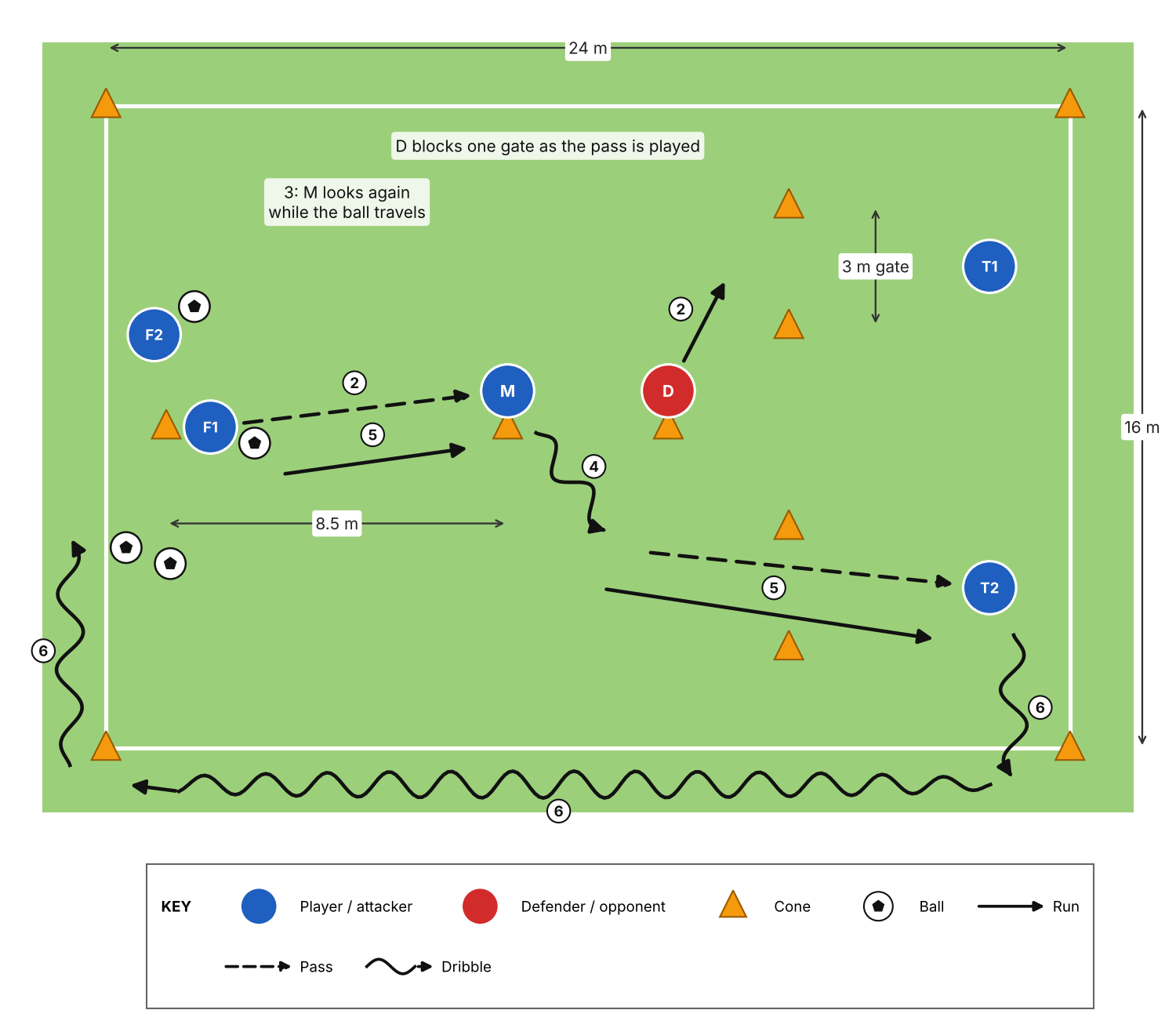
- Players: 6 shown: 2 feeders (F1, F2), 1 middle player (M), 1 defender (D) and 2 targets (T1, T2). Each area works with 5 to 9 players; extra players join the feeder line. With 12 players, set up two areas side by side, 4 m apart, with 6 in each. With 11, use areas of 5 and 6; with 10, two areas of 5. A group of 5 has only one feeder, so the target who receives passes the ball back along the outside to the feeder cone and jogs after it; reps there run about every 8–10 seconds. With 8 or 9, use one area with 4 or 5 in the feeder line and rotate D every 45 seconds. Most waits are 10–20 seconds.
- Duration: 8–10 minutes: two blocks of 4 minutes with 30 seconds rest between, plus a minute to explain.
- Equipment: 11 cones per area, 4 balls per area, a red bib for the defender.
- Area: 24 m x 16 m.
- Skills developed: scanning (checking the shoulder), receiving on the half-turn, playing forward through a gap, passing and moving.
Setup
- Mark a 24 m x 16 m area with a cone on each corner. Play runs along the 24 m length, from the feeder end to the target end.
- Place a feeder cone 1.5 m in from the middle of the feeder end. F1 stands just beside it with a ball; F2 waits just behind and to the side, also with a ball. Put 2 more balls next to the feeder cone.
- Place the middle cone 10 m from the feeder end, in the centre of the width. M starts here, 8.5 m from the feeder cone.
- Place the defender’s start cone 4 m behind the middle cone (14 m from the feeder end). D starts on it.
- Make two 3 m gates (2 cones each) 17 m from the feeder end: one centred 4 m from the top side line, one centred 4 m from the bottom side line. The two cones of each gate stand 3 m apart across the width, so passes go through along the length. The gates are 8 m apart, centre to centre.
- T1 stands 5 m beyond the top gate and T2 5 m beyond the bottom gate, 2 m in from the target end.
How to Run the Drill
- Who starts: F1 starts with the ball. Before the pass, M checks over the shoulder once to see D and both targets.
- Pass in and block: F1 plays a firm ground pass to M. As the ball leaves F1’s foot, D steps across to block one gate, standing about 1.5 m in front of it. D chooses which gate, and must not pick the same gate more than twice in a row. D may intercept a pass but may not tackle M.
- Second look: while the ball is travelling, M takes a second look over the shoulder to see which gate D has blocked.
- Turn and play: M receives on the half-turn, moves the ball 2–3.5 m towards the open gate with one or two touches, and passes through it to that target. In the diagram D blocks the top gate, so M turns down and to the right and plays through the bottom gate to T2.
- Follow your pass: M follows the pass and becomes the new target on that side. F1 runs forward to the middle cone and becomes the next M. D jogs back to the start cone.
- Back to the feeder line: the target who received (T2 here) controls the ball and dribbles back around the outside of the area to join the back of the feeder line with it. The target on the other side stays where they are.
- Restart: F2 is now the feeder. The next rep starts as soon as the new M is on the middle cone and D is on the start cone, about every 5–6 seconds.
- Scoring (optional, second block): M scores 1 point for a pass through the open gate that the target controls. D scores 1 point for an interception. Each player keeps their own total.
- Defender rotation: every 60 seconds, D joins the back of the feeder line and the coach calls the next D in a fixed order, so everyone defends at least once. In a group of 6, each player is M about every 4–5 reps.
- When to stop and reset: freeze play if M is turning before looking, or if D is moving before the pass is played.
Coaching Points
- Two looks, not one: check over the shoulder once before the feeder passes, and again while the ball is on its way. You should see M’s eyes leave the ball.
- Open body: stand side-on, hips pointing between the feeder and the gates, so you can see the ball and the space behind you.
- Back-foot receive: take the ball on the foot furthest from the feeder, so the first touch already moves towards the open gate.
- Touch out of your feet: push the first touch 1–2 m forward and towards the open gate, so the pass can follow straight away.
- Pass with the inside of the foot: plant the standing foot beside the ball, pointed at the target, and pass firmly along the ground through the middle of the gate.
- Feeder’s pass: pass firmly to M’s back foot, not straight at them.
Progression
D waits until M’s first touch before choosing a gate, so M has to look again during the touch. For a stronger group, D may also press M after blocking, as long as D comes from the side and does not tackle from behind.
Easier Variation
D chooses a gate before the feeder passes and stays there, so M only needs one look. Widen the gates to 4 m and allow M four touches.
Common Mistakes and How to Fix Them
- M faces the feeder square-on and only sees the ball. Ask M to “show your chest to the side line” before each pass.
- M looks once, too early, then ball-watches while D moves. Count the looks out loud for a block (“one… two”) and only award points to passes made after two looks.
- M guesses and turns before looking. Have D fake: step one way, then go the other. Guessers get caught quickly, and the look becomes the habit.
- The rep stalls because the new M is slow to the cone. Remind feeders to sprint in as soon as M’s pass goes through the gate.
Match Connection
When a centre-back passes into a midfielder, there is often an opponent trying to cut off the forward pass. The player who has scanned already knows which teammate is free and can play forward first time or with a quick turn. The player who hasn’t has to go backwards, or plays into trouble. Open Gate rehearses that moment over and over.
Free: Chest Dugger’s 4-week soccer training sheet
Get the printable 4-week training plan straight to your inbox, plus new drills and coaching tips by email. Unsubscribe anytime.
Your email is only used for Abiprod soccer coaching emails. Privacy policy.
Soccer Scanning Drill FAQ
What is scanning in soccer?
Scanning is a quick turn of the head, before receiving the ball, to see where teammates, opponents and space are. It lets a player decide what to do before the ball arrives.
How do you teach kids to check their shoulder?
Make it matter. In a drill like Open Gate, what is behind the player decides where the pass goes, so the player who looks gets the reward. Coach two looks before each reception.
At what age should players learn to scan?
Many coaches start introducing the habit once players can receive a pass comfortably, often around 9 or 10. It becomes more important as the game speeds up in the early teens.
Help Your Players Make Better Decisions
Scanning is really the first step of decision-making: you can’t choose the right pass if you haven’t seen it. The Chest Dugger Soccer Intelligence Book is all about speeding up those decisions on the field. If you want more games that keep players moving the ball under pressure, take a look at the Rondo Soccer eBook.
Coaching a whole season? The Chest Dugger 6 Book Soccer Coaching Bundle includes Soccer Intelligence along with Soccer Drills, Soccer Offense, Soccer Shooting Tips, Soccer Mental Toughness and Soccer Dribbling. Buying for a coach for Christmas? Order paperbacks by December 15.
Once your players can find the space, help them create it too with our guide to techniques to ditch your marker and create scoring opportunities.


