When a young defender sees an opponent coming towards them, the instinct is often to rush in and win the ball immediately. That enthusiasm is useful, but a missed tackle can open a clear route towards goal. This 1v1 defending drill gives players aged 10–12 a different challenge: protect the most dangerous space, slow the attacker down and choose the right moment to challenge.
The scoring makes that decision visible. An attacker earns more for breaking through the middle than for escaping wide, while a defender can succeed without making a spectacular tackle. Short attempts keep the practice lively, and regular role changes let every player experience both sides of the duel. Use it after your warm-up as a focused eight-minute activity, then look for the same patient defending in your small-sided game. Praise the player who stays balanced and closes the central route, as well as the player who wins possession.
DRILL NAME
Protect the Middle: Delay and Deny
PURPOSE
Teach intermediate players to stay between the ball and a central target, adjust their distance as the attacker moves, and delay before tackling an exposed ball. The attacker practises recognising space and changing direction against a live opponent.
AGE GROUP
Ages 10–12; intermediate level. Team training, following an appropriate warm-up.
PLAYERS
8–12 players. Use two groups of four for 8; three groups of three for 9; groups of three, three and four for 10; groups of three, four and four for 11; and three groups of four for 12. Each grid always has one attacker and one defender, with one or two players waiting. In a three-player group, omit Q2 from the diagram. Use the same rotation in every group.
DURATION
8 minutes: 1 minute to explain and demonstrate; 3 minutes of practice; 1 minute for feedback and a drink; 3 minutes of practice. Start an attempt every 30 seconds, with a maximum of 12 seconds of play and at least 18 seconds for recovery, ball retrieval and rotation. This gives 12 attempts per grid. In a four-player group, each player gets six active turns: three attacking and three defending. In a three-player group, each gets eight: four in each role.
EQUIPMENT
Per grid: six flat cones and one ball. Use existing team bibs if helpful; roles change each attempt, so players do not need to exchange bibs. The diagram colours identify roles, not fixed teams. The coach needs a stopwatch or timer. Total: 12 cones and two balls for 8 players; 18 cones and three balls for 9–12.
AREA
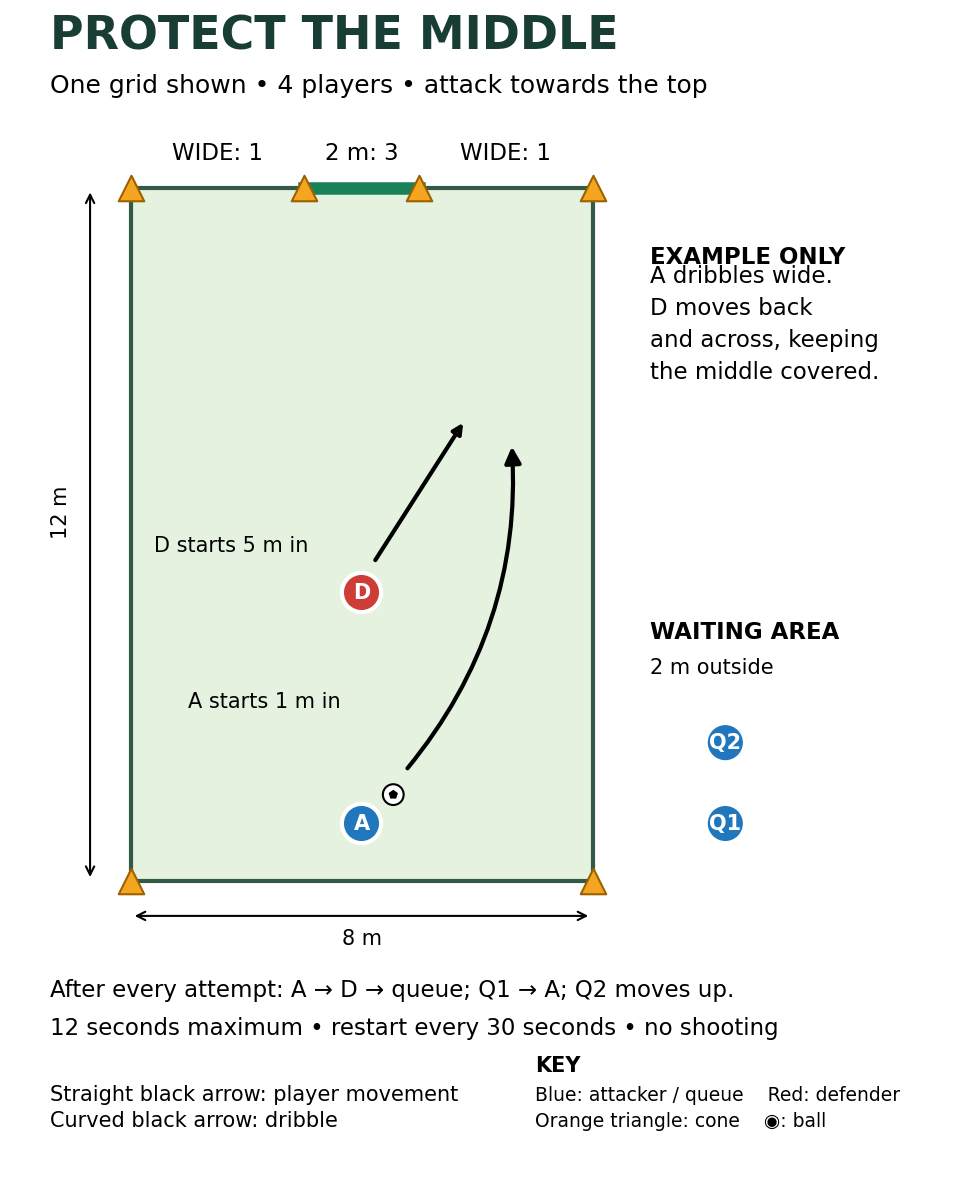
Each grid is 12 metres long and 8 metres wide. On the far end line, mark a 2-metre central gate with two cones; the remaining wide sections are 3 metres each. Leave at least 3 metres of clear run-off beyond the scoring line and at least 4 metres between grids. Put waiting players 2 metres outside a sideline near the starting end, away from the run-off. Use a flat surface and keep neighbouring grids facing the same way.
SKILLS DEVELOPED
Primary: 1v1 defending, delaying and protecting the central route.
Secondary: Balanced footwork, judging tackling distance, controlled dribbling and reading an opponent.
SETUP
- Use four cones for the corners and two for the central gate.
- The attacker A starts centrally, 1 metre inside the near end, with the ball at their feet.
- The defender D starts centrally, 5 metres inside the near end: 4 metres from A.
- Q1 and, where applicable, Q2 wait outside the sideline. Set their queue order before starting.
- Explain that this is a dribbling game: no shooting, slide tackles, pushing or grabbing. Demonstrate a controlled exit and a safe standing challenge.
HOW TO RUN
- Start together. On the coach’s signal, both players become active. The attacker has up to 12 seconds to dribble across the far end line. The defender adjusts their position to keep the central gate covered.
- Score with control. The attacker earns 3 points by dribbling the ball through the central gate or 1 through either wide section. The ball must cross the line and the attacker must make the next controlled touch within the clear 3-metre run-off. A long kick out followed by a chase does not score. No challenge is allowed once the ball has crossed the scoring line; the next touch confirms whether the exit was controlled.
- Reward the defender. Award the defender 1 point if the attacker has not crossed the line within 12 seconds, if the defender wins clear possession, or if the ball leaves a sideline or the starting end. A mere touch on the ball is not a win: play continues while it remains in the grid. A wide attacking score ends the attempt and earns the defender no point, although protecting the centre is still worth praising.
- Stop and reset. End the attempt on a score, clear defensive possession, a ball out, a foul or time. If a defender fouls, award the attacker 1 point; an attacking foul earns the defender 1. Stop immediately for any unsafe contact. Only one scoring outcome applies per attempt.
- Rotate every time. A becomes the next D; D joins the back of the waiting queue; Q1 brings the ball to A’s start. Q2, if present, moves to the front of the queue. Retrieve the ball only after play stops. Walk back into position and restart on the next 30-second signal; never chase a stray ball into a neighbouring live grid.
- Coach briefly. After the first six attempts, ask: “Which space are you protecting?” and “What tells you the ball is safe to challenge?” Give one cue, then repeat six attempts. Keep individual scores for fun, but assess defending by positioning and decisions as well as points.
COACHING POINTS
- Cover the middle first. Keep your position between the ball and the central gate. Angle your stance to encourage the attacker towards a wide exit without offering an easy cut back inside.
- Arrive under control. Close space while the ball is safely distant, then shorten your steps. Around 1–2 metres can be a useful starting gap, but adjust to the attacker’s speed and touch rather than standing at a fixed distance.
- Stay balanced. Bend your knees, stay light on your feet and move back and across as needed. If beaten, turn and recover rather than crossing your feet while trying to shuffle at full speed.
- Read the touch. Watch the ball and recognise a heavy touch. Challenge when you can reach it without lunging through the attacker; otherwise keep delaying.
- Recognise success early. Praise forcing a turn, slowing a forward run or preventing an inside cut. Winning possession is not the only useful defensive action.
PROGRESSION
Once defenders regularly protect the centre, widen the central gate from 2 to 3 metres, leaving 2.5 metres on either side. Keep the same starting positions, timing and scoring. The larger high-value target demands better positioning. Change only this one constraint so players can recognise its effect; the diagram shows the original 2-metre version.
EASIER VARIATION
For defenders who are struggling, keep the base layout but begin with attackers moving at walking pace for one three-minute block. Allow standing ball wins and retain the same scoring and rotations. Return to normal speed once defenders can stay balanced and follow a change of direction.
COMMON MISTAKES
- Charging straight at the ball: cue “quick approach, small final steps”; rehearse stopping in balance before restarting.
- Following the attacker too far wide: point out the space between the ball and central gate. Ask the defender to protect the inside cut while adjusting their gap.
- Backing away without influencing play: encourage the defender to close space when the attacker slows or turns away, and to act on a genuinely loose touch.
- Reaching with a stretched leg: reset the feet and move the body into a balanced challenging position instead of stabbing from too far away.
- Attacker kicks through an exit: remind players that the next touch must be controlled inside the run-off; reward carrying the ball, not simply clearing the line.
MATCH CONNECTION
This represents a defender facing a ball carrier with a dangerous central route behind them. Delaying can give teammates time to recover, while showing the attacker wide can reduce the immediate central threat. In a match, the best direction also depends on cover, the touchline and opponents nearby: “show wide” is not an automatic rule for every situation. In your next small-sided game, look for a defender who stays on their feet, protects the route to goal and challenges after a loose touch.
For more age-appropriate sessions to build around this practice, explore Soccer Drills for Kids Ages 8–12 by Chest Dugger. Its illustrated drills and season-long training program helps coaches develop a wider range of skills alongside defending.