Accurate passing is about more than hitting a target. Players need to control the ball, look up and judge when a teammate is ready to receive. This Coerver-inspired passing drill brings those habits together in a short practice for 8–12 players.
Diagonal Pass and Switch uses a narrow cone gate to encourage precision and a simple exchange of positions to keep players moving after the pass. Set it up as an eight-minute technical activity, adjust the distances to your group and finish with a small-sided game so players can apply the same habits under pressure.
Diagonal Pass and Switch
PURPOSE: Improve the weight and direction of inside-foot passes, first-touch control and the timing of movement to receive. Players pass through a narrow gate, then move away so a teammate can arrive in the receiving position. This original, Coerver-inspired exercise links technical repetition with the pass-and-move habits used to maintain possession; it is not an official Coerver drill.
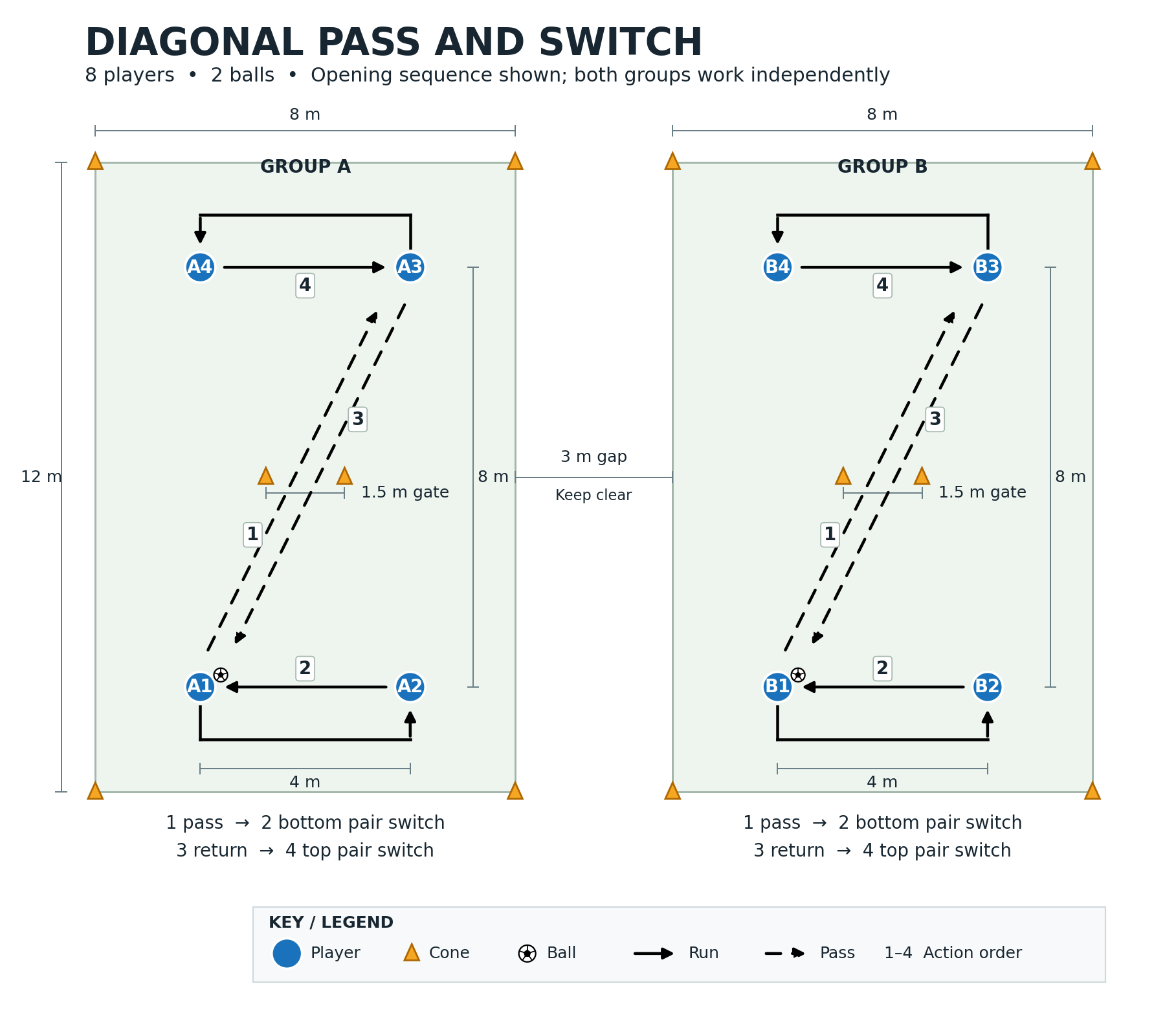
DIAGRAM:
AGE GROUP: All ages, intermediate ability. Use the shorter distances below for younger players who cannot comfortably pass across the full area.
PLAYERS: Eight illustrated: two independent groups of four, A1–A4 and B1–B4. For nine, use groups of four and five; for ten, two groups of five; for eleven, groups of five and six; for twelve, three groups of four. In a five-player group, add one player to the support line at one end; with six, add one at each end. Extras stand 1 m to the outside of the support player, away from the passing lane. After passing, join the back of your own end’s support line; its front player becomes the receiver and the next waiting player advances to the support position. Change which end has the extra player halfway through a five-player group’s practice.
DURATION: Eight minutes: one minute to demonstrate, then six 45-second rounds with five 15-second coaching/reset breaks, and 75 seconds to review.
EQUIPMENT: For eight players: 12 flat cones and two balls. For twelve: 18 cones and three balls. No goals or defenders.
AREA: Each group uses an 8 m-wide × 12 m-long rectangle. Leave a clear 3 m safety gap between rectangles. Two grids occupy 19 × 12 m, excluding outside clearance. For younger players, use 7 × 10 m grids and reduce the distance between end pairs from 8 m to 6 m.
SKILLS DEVELOPED: Precision passing; directional first touch; running off the ball; timing and communication.
SETUP:
- Mark each rectangle with four corner cones. Place two more cones across its centre to make a 1.5 m-wide gate, parallel to the short ends.
- Position two players at each end, 2 m inside the end boundary and 4 m apart. The two pairs are therefore 8 m apart lengthways; the diagonal pass is approximately 9 m.
- Looking up the diagram, A1 starts bottom left with the ball; A2 starts bottom right as support. A3 starts top right as receiver; A4 starts top left as support. Group B copies this with B1–B4 and its own ball.
- Keep the space behind each pair clear. The passer’s return route goes 1 m behind the end pair before crossing sideways; the support player uses the direct sideways route. Use controlled jogging, not sprinting.
HOW TO RUN THE DRILL:
- Pass: A1 passes diagonally along the ground through the gate to A3. Group B starts independently with B1 passing to B3.
- Move after release: As soon as the ball leaves A1’s foot, A2 moves sideways into A1’s vacated receiving position. A1 turns away from the passing lane, jogs 1 m towards the bottom boundary, crosses behind A2’s route and moves into A2’s former support position. These separate routes prevent the pair running into each other.
- Control and return: A3 takes a settling first touch, looks up and passes back through the gate to A2 as A2 arrives balanced and ready. Aim for two touches, but allow an extra settling touch if the new receiver is not ready. Never rush a pass at a teammate still crossing the lane.
- Switch the other end: Immediately after A3’s pass, A4 moves sideways into A3’s receiving position. A3 uses the route 1 m behind the top pair to reach A4’s former support position.
- Continue: A2 now passes through the gate to A4 and exchanges with A1. A4 returns to A1 and exchanges with A3. The initial arrangement is restored. Repeat continuously: every player receives and passes once in each four-pass cycle.
- Reverse the diagonal: At each 45-second break, reset the original player positions. Alternate which bottom player starts with the ball: bottom left in odd rounds and bottom right in even rounds. When bottom right starts, pass to top left; the support movements and rear return routes reverse. Encourage both feet without forcing an awkward pass.
- Restart and reset: There is no scoring. If the ball hits a gate cone or leaves the grid, stop that group, retrieve it and restart from either occupied receiving position once everyone is ready. Stop immediately for crossing running routes or a ball entering from another grid. Use the scheduled breaks for corrections; pause earlier if repeated errors show that the distance is too long or the gate too narrow.
COACHING POINTS:
- Plant the non-kicking foot beside the ball, point it at the target and use a firm ankle with the inside of the passing foot.
- Send the ball through the middle of the gate at a pace the receiver can control; keep the follow-through low to avoid bouncing passes.
- Scan before the ball arrives. Take the first touch slightly in front of the body, close enough to pass without chasing it.
- Start the support run when your teammate releases the pass. Arrive side-on, slow down and show a clear target before the return ball is struck.
- Pass to the arriving player’s feet, not simply towards the gate. Look up again if their movement is delayed.
- After passing, turn and jog along the rear route. Do not backpedal blindly or cut across the support player’s path.
PROGRESSION: Reduce the gate to 1 m and use a maximum of two touches, provided players can still complete the exchange safely. The receiver may pause over the controlled ball while the new target arrives. Restore an extra touch if timing deteriorates; do not demand one-touch returns that outrun the movement.
EASIER VARIATION: Use the 7 × 10 m grid, end pairs 6 m apart, a 2 m gate and up to three touches. The receiver may hold the ball until the pair has completed its exchange. Keep the same movement pattern.
COMMON MISTAKES:
- Passing before the new receiver arrives: Have the receiver call “ready”; allow one extra settling touch.
- Players collide during the exchange: Rehearse without the ball: support straight across; passer 1 m behind, then across and forward.
- Passes clip a cone repeatedly: Reduce pace and aim centrally; widen the gate until accuracy improves.
- First touch travels across the gate’s passing line: Receive behind the ball and cushion it slightly forward, rather than sweeping it sideways.
MATCH CONNECTION: The drill rehearses releasing a pass, clearing a space and allowing a teammate to arrive as a new option. The gate rewards an accurate ground pass through a narrow channel; the moving receiver encourages players to judge timing as well as direction. Follow it with a small-sided game to practise those choices against opponents.