
Winning the ball is only the beginning. The next touch, pass, and supporting run determine whether your team launches an attack or immediately has to defend again. Players need practice recognizing when to play forward quickly, when to protect possession, and how to deliver a longer pass that a teammate can actually control.
These two soccer transition drills connect defending with purposeful attacking. The first gives players repeated opportunities to regain possession and find a wide outlet. The second places those decisions inside a competitive game, where opponents recover and teammates must time their forward runs.
Both activities work with 8-12 intermediate players and take approximately eight minutes. Adjust the space and passing distance to your group rather than asking younger players to copy adult-sized long balls. A firm ground pass that breaks pressure is just as valuable as a lofted delivery. The objective is to find a teammate with an advantage, not simply kick the ball farther.
DRILL NAME: Win It, Find the Wide Outlet
PURPOSE:
Train players to change from pressing the ball to creating an attacking passing angle immediately after a regain. The ball winner and supporting teammate work together to release a longer pass toward one of two wide outlets, developing the first actions of a counterattack.
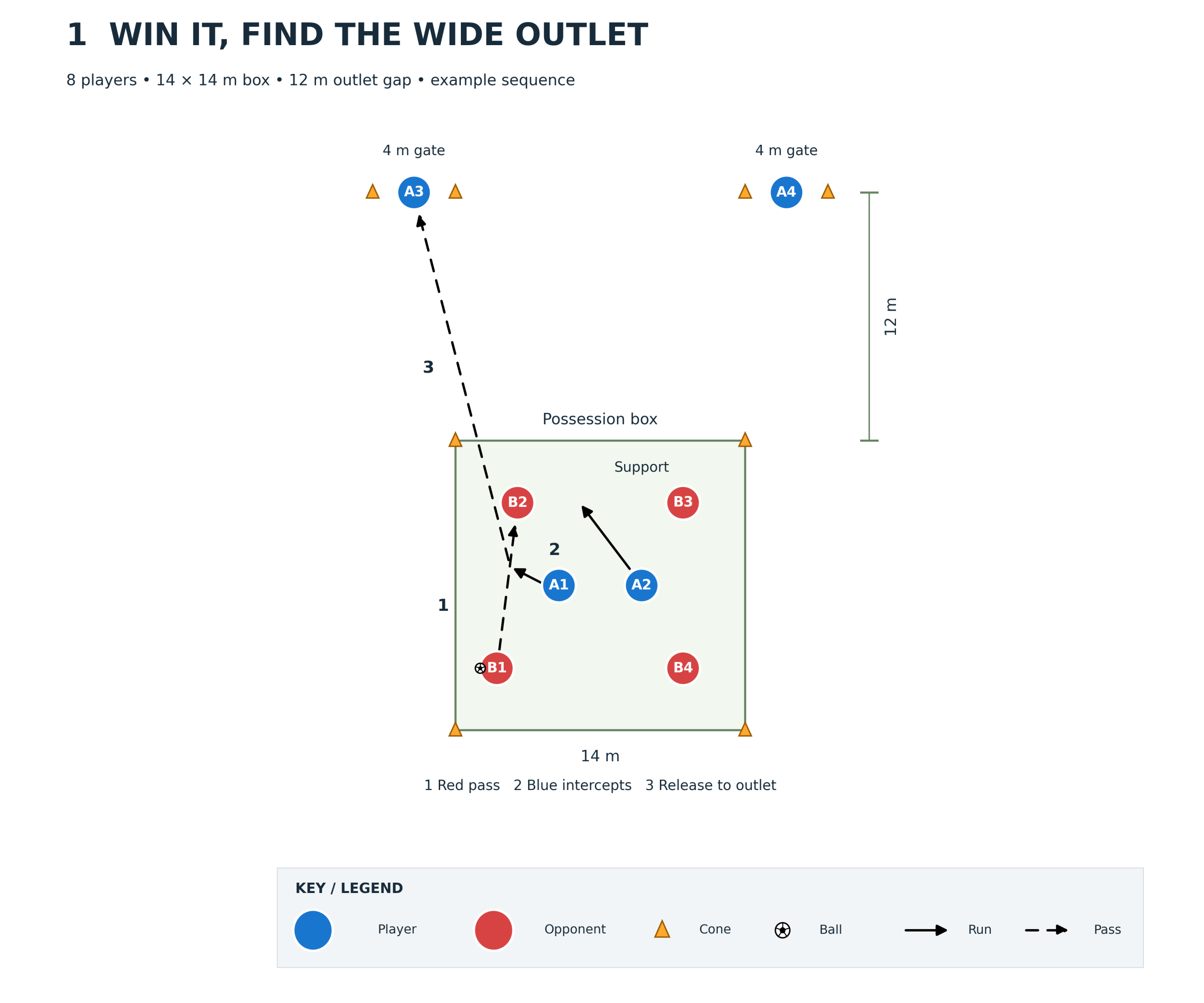
Markers show starting positions. The example sequence is B1 passing toward B2, A1 intercepting, and A1 releasing A3. A2 moves to support. These are possible actions, not compulsory passes.
AGE GROUP:
Intermediate youth through adults, using the distance adjustments below. For very young players, use the easier variation and introduce one instruction at a time.
PLAYERS:
Eight illustrated:
- Four red possession players: B1–B4.
- Two blue ball-winning players: A1–A2.
- Two blue outlets: A3–A4.
For larger groups, keep two outlets and adjust the players inside:
| Total players | Inside the box | Outlets |
|---|---|---|
| 8 | 4 v 2 | 2 |
| 9 | 4 v 3 | 2 |
| 10 | 4 v 4 | 2 |
| 11 | 5 v 4 | 2 |
| 12 | 5 v 5 | 2 |
The larger inside group starts in possession. Colors show the initial roles; players keep their bibs when roles rotate.
DURATION:
Eight minutes: four 90-second rounds, each followed by 30 seconds to rotate, coach, and recover.
EQUIPMENT:
Eight cones, two bib colors, and 3–4 balls. Use one ball at a time, with spares beside the coach outside the area. No goals.
AREA:
A 14 × 14 m possession box, with two 4 m receiving gates positioned 12 m beyond its far edge. Total marked footprint: 26 m long × 22 m wide.
SKILLS DEVELOPED:
- Regaining possession.
- Scanning and forward passing.
- Long-pass accuracy.
- Supporting movement and first touch.
SETUP:
- Mark the possession box with four cones.
- Make two 4 m gates on a line 12 m beyond the box. Position one on each side, with each gate’s inner cone aligned with the corresponding side of the box.
- Leave at least 3 m of clear runoff behind the gates.
- B1–B4 begin approximately 2–3 m inside the box’s corners. A1 and A2 start centrally, 4 m apart. B1 has the ball.
- A3 and A4 start in the middle of their respective gates. They may move laterally along their gates to offer passing angles.
- Nobody waits in the space between the box and gates.
Distance adjustments: For younger players, use a 10 × 10 m box and a 6–8 m gap to the gates. Older, capable players can use a 16 × 16 m box and a 15–18 m gap. For 10–12 players, begin with a 16 × 16 m box and adjust the outlet gap separately.
HOW TO RUN THE DRILL:
- Start with possession. B1 passes to any red teammate inside the box. Red keeps possession with unrestricted touches; blue presses and attempts to intercept. Inside players remain in the box.
- React to the regain. When blue wins controlled possession, red immediately counterpresses. The ball winner checks both outlets. The other blue player moves 3–5 m diagonally away from pressure to offer a short passing option.
- Release the outlet. Blue can pass directly to either outlet or combine inside the box first. There is no compulsory short pass. The longer delivery must leave from inside the box and travel through the chosen gate. Inside players do not chase into the gap.
- Score for control. Blue earns one point when the outlet controls the delivery within two touches and finishes no more than 3 m behind the gate. Red earns one point for five consecutive passes, then starts a new pass count without stopping.
- Restart promptly. After any outlet attempt, end that repetition. The receiver returns the ball along the ground to a red player, or the coach supplies a spare. Alternate the red starting player. If red wins possession back inside the box before an outlet attempt, continue immediately with its pass count reset.
- Reset unsuccessful transitions. Restart with red if the ball leaves the box other than through a blue outlet attempt, or if blue has not released within eight seconds of winning possession.
- Rotate every round. With eight players, use four pairs: A1/A2, A3/A4, B1/B2, and B3/B4. Each pair cycles through ball winners → outlets → first possession pair → second possession pair → ball winners. Everyone experiences every role.
- Adapt rotations for 9–12 players. Replace both outlets each round with two inside players who have had the least outlet time. Rebalance the inside groups and alternate which group starts in possession.
- Stop when necessary. Pause for unsafe challenges or a loose ball entering another activity. Use standing tackles and restart once the area is clear.
COACHING POINTS:
- Scan toward the outlets while closing down, then check again when possession becomes secure.
- Take the first touch away from the nearest opponent to open a passing lane.
- Move diagonally into the ball winner’s view; do not offer support from behind an opponent.
- For a driven ground pass, plant the non-kicking foot beside the ball, firm the ankle, and strike through its middle with the instep.
- Aim toward the receiver’s available foot. The outlet should receive side-on and cushion the ball into the next step.
PROGRESSION:
Allow blue no more than two completed passes inside the box before releasing the outlet. Keep the eight-second limit.
EASIER VARIATION:
Shorten the outlet gap to 6 m and give the ball winner two seconds without a tackle after a controlled regain. Use ground passes and remove the eight-second limit.
COMMON MISTAKES:
- Blind clearance: Ask the passer to identify an outlet before striking. Award points only for controlled receptions.
- Support player crowds the ball: Briefly demonstrate a diagonal passing angle 3–5 m away.
- Pass repeatedly overshoots: Shorten the gap and require three controllable deliveries before increasing it.
MATCH CONNECTION:
A midfielder wins possession under pressure, uses a nearby teammate if needed, and releases a winger before the opposition can reorganize.
DRILL NAME: Regain and Release End-Zone Game
PURPOSE:
Develop the decision to counterattack quickly when a forward lane opens, while allowing players to retain possession when it does not. This game adds recovering defenders, moving receivers, and transitions in both directions.
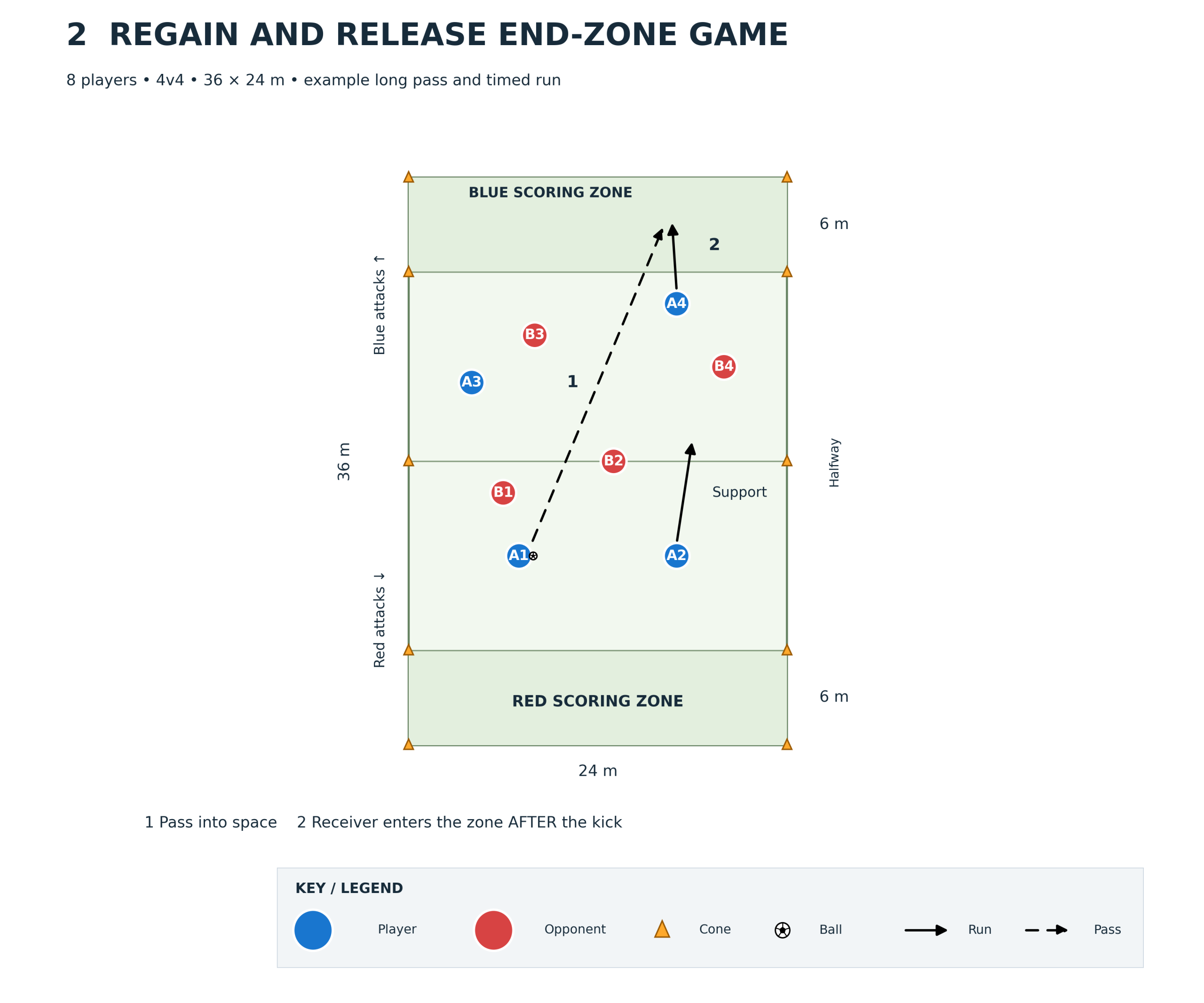
Blue attacks upward; red attacks downward. The example shows A1 releasing a long pass, A4 entering the scoring zone after the kick, and A2 advancing in support. Defenders are live; their recovery movements depend on the attack.
AGE GROUP:
Intermediate youth through adults. Use shorter spaces for younger players. “Long” means a purposeful pass over a suitable distance, not maximum-power kicking.
PLAYERS:
Eight illustrated, playing 4v4.
- 10 players: 5v5.
- 12 players: 6v6.
- 9 or 11 players: 4v4 or 5v5 plus one neutral supporting the team in possession.
The neutral wears a third bib color, stays outside both end zones, and cannot score. Rotate this role after each round.
DURATION:
Eight minutes: four 90-second games, each followed by 30 seconds for recovery and one coaching point. Change ends after game two.
EQUIPMENT:
Ten cones, two sets of bibs, and 3–4 balls. Use one ball at a time, with spares beside the coach. No goals.
AREA:
36 m long × 24 m wide, including a 6 m end zone at each end. The central playing area is 24 × 24 m. Halfway divides the full pitch into two 18 m halves.
SKILLS DEVELOPED:
- Decision-making after a regain.
- Long passing into space.
- Timing forward runs.
- Recovery and supporting movement.
SETUP:
- Place four corner cones, four where the end-zone boundaries meet the touchlines, and two at halfway.
- The diagram’s lines connect these markers; painted lines are unnecessary.
- Leave at least 3 m of clear runoff.
- Blue attacks the far end zone; red attacks the near end zone.
- All players start in the central playing area. A1 has the ball in blue’s own half, with the nearest opponent at least 3 m away.
- A1 and A2 start deeper, A3 offers a wider option farther forward, and A4 begins just outside the attacking end zone. Red spreads through the central area.
- These are starting positions, not fixed stations.
For younger groups, use 28 × 20 m with 5 m end zones. For 10–12 older players, use 40 × 28 m with 6 m end zones.
HOW TO RUN THE DRILL:
- Begin the game. A1 starts in possession. This opening possession is a normal attack; transition bonuses begin only after a live regain. Use unrestricted touches and no offside rule.
- Score by receiving. Earn one point by passing to a teammate who controls the ball inside the attacking end zone. Dribbling into the zone does not get a point.
- Time the entry. An attacking receiver can enter the end zone only after the pass toward it has been kicked. Defenders may enter whenever necessary. Nobody remains stationed in an end zone between attacks.
- Reward a transition pass. After winning controlled possession in its own half, a team has a bonus window covering its next three attempted passes. Award two points total if one of those passes travels directly from its own half into the attacking end zone and a teammate controls it there.
- Allow a settling pass. The ball winner can use a short supporting pass first. The eventual bonus delivery must still be struck from the team’s own half. A regain in the opponents’ half does not activate the bonus.
- Coordinate the runs. The highest teammate moves to reveal a passing lane, then accelerates into the zone after the kick. The nearest teammate offers diagonal support. Another stays underneath the attack to provide a safer option.
- Keep the decision realistic. Opponents immediately recover or press. If the long passing lane is blocked, retain possession and work toward an ordinary one-point score. The bonus expires after three attempted passes or loss of possession.
- Restart after a score. The conceding team starts with a stationary ball at the midpoint of its own end-zone boundary. All other players return to the central area; opponents retreat at least 3 m. Play becomes live after the first pass. This restart does not count as a regain.
- Handle other stoppages. If the ball goes out, the other team passes in from the exit point, with opponents 3 m away. It cannot score directly from that restart pass. An attacker entering the zone early gives the defending team the same restart used after a score.
- Keep everyone involved. An unsuccessful end-zone pass that stays in play remains live. Players exchange deep, wide, and high roles throughout. Change the starting ball carrier between rounds; stop only for safety or a recurring misunderstanding.
COACHING POINTS:
- Lift the head after a regain and check whether the forward lane is genuinely open.
- Receivers should move sideways or check toward the ball before accelerating. Cross the zone boundary only after the kick.
- Lead the receiver with enough pace to beat recovery, while leaving room to control before the end line.
- Keep a diagonal supporting option and one deeper player available if the counterattack closes.
- Cushion the receiving touch inside the zone. Use ground passes as the default; older players receiving lofted deliveries can use their feet or thigh without introducing contested heading.
PROGRESSION:
Reduce the bonus window from three attempted passes to two. Keep ordinary one-point scores available so players still have a reason to retain possession.
EASIER VARIATION:
Shorten the pitch and begin with one-point scoring only. Once players time their runs reliably, introduce the transition bonus with a four-pass window.
COMMON MISTAKES:
- Forcing every regain forward: Ask the player to identify the defender blocking the lane and use support when necessary.
- Receiver waits in the zone: Reinforce “enter after the pass” and apply the restart consistently.
- Everyone sprints forward: Assign one player to remain underneath the ball for that round, then rotate the responsibility.
- Long pass runs out untouched: Reduce the pace or lead distance. Shorten the pitch if the required pass exceeds players’ reliable range.