

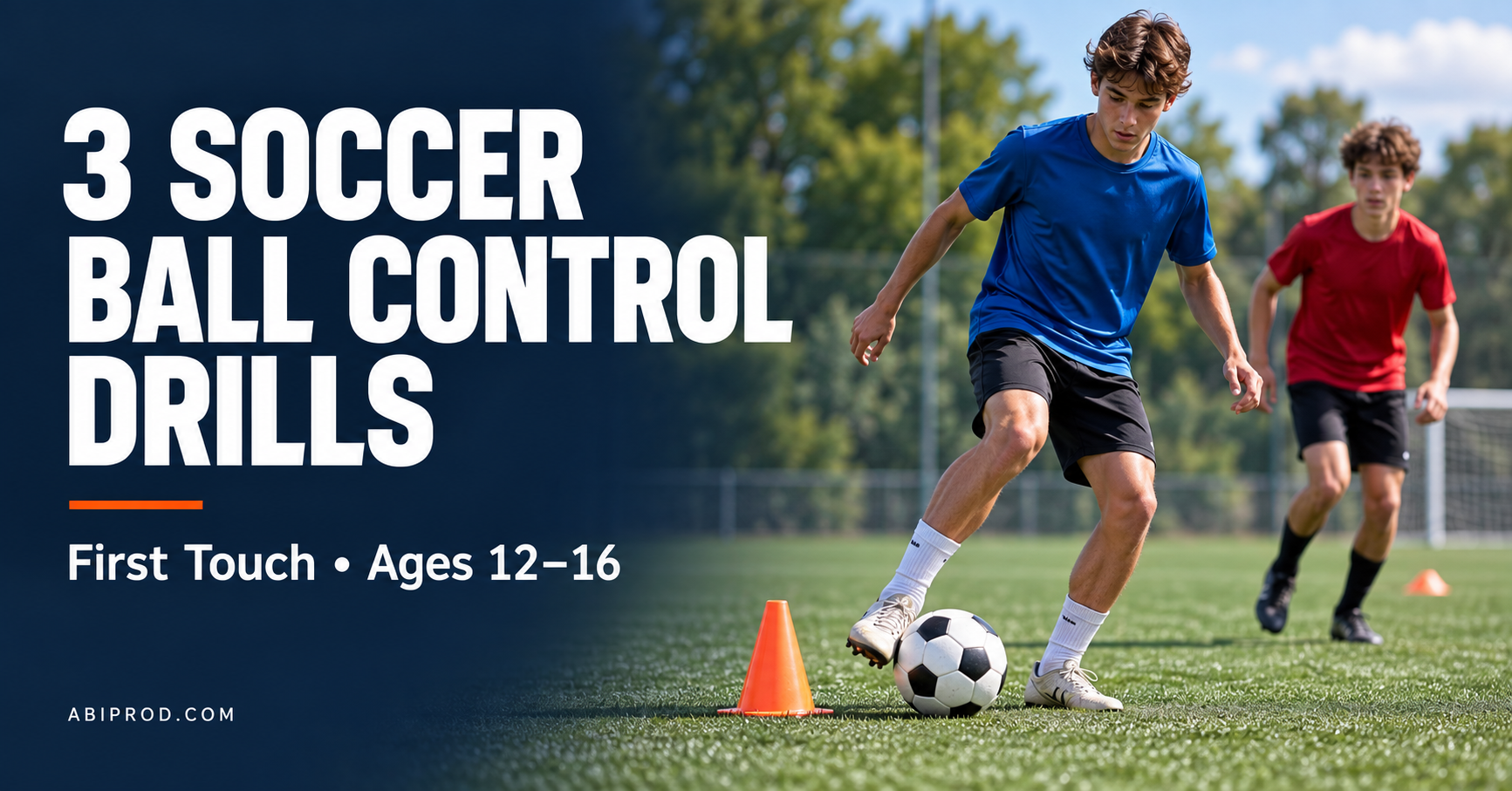
Good ball control gives a player options. A well-directed first touch can create space to pass, carry the ball away from pressure, or keep an attack moving.
These three drills help intermediate young players connect their first touch to their next action.
Start with paired repetitions, add a defender, and finish with a game. Each activity takes eight minutes and accommodates 8–12 players. Allow extra time for a warm-up and changes of setup.
1. DRILL NAME: Receive Through the Gate
PURPOSE: Develop a first touch that moves the ball into useful space while keeping it within playing distance. Players receive across their body, carry through a gate, and turn to return a pass, as they might when receiving with space behind them in midfield.

AGE GROUP: 12–16 years; intermediate.
PLAYERS: Eight illustrated: four pairs, A1–A2 through D1–D2. For 10 or 12, use five or six lanes. For nine or 11, add a third player to one lane; the third player waits outside the lane at its midpoint and replaces the passer after each return pass. Rotate through all three roles, so nobody waits for more than one repetition.
DURATION: Eight minutes: one minute to demonstrate, then three two-minute rounds with two 30-second coaching breaks.
EQUIPMENT: One ball and eight cones per lane; 32 cones and four balls for the illustrated setup.
AREA: Each lane is 12 × 4 m. Leave 2 m between lanes; four lanes occupy 12 × 22 m overall.
SKILLS DEVELOPED: Directional first touch; close control; turning; accurate ground passing.
SETUP: Mark each lane with four corner cones. Put a 2 m gate across its centre line 2 m from each end, using another four cones. Players start on the centre line, 3 m from their respective ends, leaving 6 m between them. The player at the left end has the ball. Each gate is 1 m behind its receiver’s starting position.
HOW TO RUN THE DRILL:
- A1 passes along the ground to A2. All pairs work simultaneously in their own lanes.
- While the pass travels, A2 checks the space behind, turns side-on, and receives across the body. Direct the first touch back toward the gate behind A2, away from the passer.
- A2 follows the ball through that gate, using one additional close touch if needed. Turn before the end line and pass back to A1 through the lane. A1 remains available at the original starting position.
- After releasing the return pass, A2 jogs back to the original receiving position. A1 now receives the ball from A2 and repeats. Players alternate continuously; they do not swap ends.
- Count a successful reception when the first touch travels toward the gate and the receiver carries through without touching a cone or losing the ball outside the lane. Keep a pair total for each round.
- If the ball leaves the lane, the nearest player retrieves it while the partner resets. Resume from the original positions with a ground pass. Do not chase into an active neighboring lane; ask that pair to stop first.
- In round one, use the preferred foot; in round two, use the other foot where possible; in round three, alternate feet. Stop at the scheduled breaks, or immediately if balls regularly enter other lanes. Reduce passing speed before restarting.
COACHING POINTS:
- Look behind before the pass arrives, then return your eyes to the ball.
- Open your hips so the receiving foot can guide the ball toward the gate without trapping it under your body.
- Soften the ankle and withdraw the foot slightly on contact; keep the ball within one running stride.
- Accelerate after the first touch instead of reaching for the ball with a second stretched touch.
- Take small touches near the end line, turn under control, and look up before returning the pass.
PROGRESSION: Narrow both gates to 1.5 m and increase the pace of the ground pass. Keep unlimited touches for the turn and return.
EASIER VARIATION: Widen the gates to 3 m and allow a settling touch before the directional touch.
COMMON MISTAKES:
- First touch stops dead: Open the body earlier and point the receiving surface toward the gate.
- Ball runs beyond the end line: Reduce the force of contact; aim for a first touch of roughly 1 m.
- Player returns the pass without looking: Require a brief head lift after the turn to locate the partner.
MATCH CONNECTION: A midfielder receives with room to turn, takes the ball out of the original passing line, and prepares the next action.
2. DRILL NAME: Receive and Escape
PURPOSE: Help players protect their first touch from pressure behind them and carry into space on either side. The receiver must scan, choose an exit, and place the body between the opponent and the ball.

PLAYERS: Nine illustrated: three groups, each with a blue server, blue receiver and red defender. For eight, use two trios and one pair; the pair practices the same receiving pattern without a defender, and exchange that pair with two members of a trio each round. For 10–12, use three grids, adding one extra server to each grid as needed. In a group of four, the spare server waits outside the bottom boundary and enters through the rotation below.
DURATION: Eight minutes: one minute to explain, then three two-minute rounds with two 30-second breaks.
EQUIPMENT: Eight cones and one ball per grid; 24 cones, three balls and three defender bibs for the illustration.
AREA: Three 8 × 8 m grids with 3 m clear gaps: 30 × 8 m overall. Keep additional clear space outside the exit gates and behind the servers.
SKILLS DEVELOPED: Scanning; directional first touch; shielding; controlled dribbling under pressure.
SETUP: Use four corner cones per grid. Centre a 2 m cone gate on each side boundary, adding four cones. The server starts at the bottom midpoint, 4 m from the receiver at the centre. The defender starts 2 m behind the receiver, toward the top boundary. Each receiver is 4 m from either side gate. The server starts with the ball. Labels A1/A2/A3 identify the first group’s server, receiver and defender; B and C repeat these roles.
HOW TO RUN THE DRILL:
- The receiver checks over both shoulders. The server passes along the ground to the receiver’s feet.
- The defender becomes active only when the receiver first touches the ball. The receiver takes that touch toward either side gate, follows the ball, and tries to dribble through it within six seconds.
- The defender tries to win the ball or force it out. Use standing challenges only, with no pushing or tackling through the receiver’s legs from behind. The server stays out of the contest.
- The receiver scores one point by carrying the ball through a gate under control, with the ball still within one stride. A defender’s touch alone does not end play; clear possession, a ball out of bounds, or six seconds does.
- End the repetition after any of those outcomes. The defender does not counterattack. Retrieve the ball and rotate after every attempt: server → receiver → defender → server. Walk to the new positions before restarting; transfer the defender bib during the reset.
- With four players, rotate server → receiver → defender → waiting server → active server. The incoming server brings the retrieved ball to the starting spot. Every player therefore receives once in four short attempts.
- All grids work independently. At each coaching break, reset the roles and restart. Stop immediately for unsafe challenges; rehearse the defender’s approach at walking pace before resuming.
COACHING POINTS:
- Scan before the pass, then check again as it travels if time allows.
- Bend the knees and receive side-on; avoid standing square with both feet planted.
- Take the first touch toward the chosen gate and away from the defender’s approach.
- Keep the body between the defender and ball; use arms for balance without pushing or holding.
- Take shorter touches while shielding, then a slightly longer touch once clear of pressure.
- Cross the gate with the ball under control, rather than kicking it through from a distance.
PROGRESSION: Release the defender when the server strikes the pass instead of on the receiver’s first touch. Keep the same starting distance and six-second limit.
EASIER VARIATION: Start the defender 3 m behind the receiver and allow only shadowing, with no tackles. Introduce standing challenges once receivers can scan and turn reliably.
COMMON MISTAKES:
- Receiver turns toward pressure without checking: Pause before the next pass and ask the player to locate the defender over each shoulder.
- First touch goes directly at a cone: Aim toward the middle of the gate, leaving room for a second touch.
- Receiver shields without escaping: Keep the six-second limit and prompt the player to accelerate once a route opens.
- Defender starts early: Return both players to their starting spots and repeat the release cue.
MATCH CONNECTION: A forward or midfielder receives with an opponent behind, protects the ball, and turns into an open channel.
3. DRILL NAME: Receive into the End Zone
PURPOSE: Put ball control and first touch into a competitive game. Players create a passing lane, arrive at the right moment, and use their first touch to keep the ball playable while opponents apply pressure.

AGE GROUP: 12–16 years; intermediate.
PLAYERS: Eight illustrated, 4v4: blue A1–A4 and red B1–B4. For 10 or 12, play 5v5 or 6v6. For nine or 11, play 4v4 or 5v5 plus one neutral player who supports the team in possession, stays in the central area, and cannot score. Swap the neutral every minute.
DURATION: Eight minutes: one minute to explain, then three two-minute games with two 30-second coaching breaks.
EQUIPMENT: Eight cones, one match ball, two spare balls kept with the coach outside the area, and bibs for the teams. Use a distinct bib for an optional neutral player.
AREA: 24 × 18 m for 4v4, including a 3 m end zone at each end. For 5v5, use 28 × 20 m; for 6v6, 32 × 22 m. Keep the end zones 3 m deep.
SKILLS DEVELOPED: First touch under pressure; receiving on the move; close control; supporting movement.
SETUP: Mark the four outer corners and the four points where the end-zone lines meet the sidelines: eight cones in total. There are no goals. In the illustration, blue attacks right and red attacks left. All eight players start in the central 18 × 18 m area; A2 has the ball in its own half, with teammates spread ahead and to either side. Opponents start at least 3 m from the ball. The labelled arrows show one possible scoring action, not a compulsory pattern.
HOW TO RUN THE DRILL:
- Blue starts with a ground pass from A2 to a teammate. Play normal possession soccer in the central area, using unlimited touches.
- Score by passing to a teammate who runs into the attacking end zone and takes their first touch inside it, keeping the ball within one stride and inside the field. Dribbling into the zone does not score.
- An attacker may enter the zone only after the intended pass has been struck and must start the run from the central area. If no reception follows, leave the zone immediately. Defenders may track the run into the zone; there is no offside rule.
- In the illustrated example, A2 passes into the right zone and A3 runs to meet it after the pass is struck. A3 cushions the first touch inside the zone. Other players adjust freely to support or defend; there are no fixed positions or queues.
- After a goal, the conceding team restarts with the ball at the centre. Both teams return to the central area and opponents retreat 3 m. Each team keeps its assigned attacking direction throughout: red attacks left and blue attacks right.
- If the ball leaves the field, the other team restarts with a ground pass from the exit point, with opponents 3 m away. End-zone entry and scoring rules still apply. For a foul or an attacker entering early, give the opponents a ground-pass restart at the incident point. Every restart must first reach a teammate in the central area before a scoring pass is allowed.
- After a turnover in an end zone, the new team may pass or dribble out toward the opposite end. Players who have not received recently should be encouraged to find new passing angles; do not impose a compulsory pass sequence.
- Stop at the end of each two-minute game to give one correction and restart at the centre. Also stop for unsafe contact or persistent early entry; show the timing once and resume quickly.
COACHING POINTS:
- Check both the defender and available space before asking for the ball.
- Move diagonally to open a passing lane instead of standing behind an opponent.
- Start the scoring run after the pass is struck; accelerate to arrive with the ball.
- Match the speed of the ball and soften the receiving foot so the first touch stays inside the end zone.
- In central play, direct the first touch away from pressure and toward the next pass or dribble.
- After passing, move to a new supporting angle rather than watching the ball.
PROGRESSION: A scoring receiver must also complete a pass back to a teammate in the central area before the point is awarded. Defenders remain active throughout; the original timing and first-touch requirements still apply.
EASIER VARIATION: Make the end zones 4 m deep and prevent defenders from entering them. Keep the rule that attackers enter only after the pass is struck.
COMMON MISTAKES:
- Attackers wait inside the end zone: Reset the player into the central area and rehearse the pass-then-run cue.
- First touch crosses the end line: Shorten the final stride and cushion the ball instead of poking at it.
- Everyone crowds around the ball: Ask the team in possession to offer support on both sides and ahead of the ball.
- Players force the scoring pass: Encourage a safe supporting pass until the receiving lane opens.
MATCH CONNECTION: A player times a run to receive a through pass or cutback, then controls the ball in limited space with a defender nearby.
Bring the First Touch into the Game
Use the same question throughout the session: “Where should your first touch take the ball?” In the first drill, the gate provides the answer. In the second, the defender influences the choice. In the final game, players must read the space, teammates, and pressure for themselves.
Look for three visible improvements: earlier scans, fewer touches trapped under the feet, and more receptions that set up a useful next action.
Not sure which drills suit your child’s age? Use our free Soccer Age Group Calculator to check their age group and find recommended drills.

