

Drill 1: Pass and Move Squares
Purpose
This drill develops short passing, first touch, movement after passing, and awareness of the next available teammate. Players learn that a pass is not the end of their involvement: after releasing the ball, they immediately move into a new position to support the next action.
The design follows the child-centred approach in your reference material: simple organization, lots of activity, technical repetition, and limited tactical complexity. Your reference also emphasizes passing and receiving as core skills for this age group and gradually adding pressure rather than beginning with excessive complexity.
Diagram
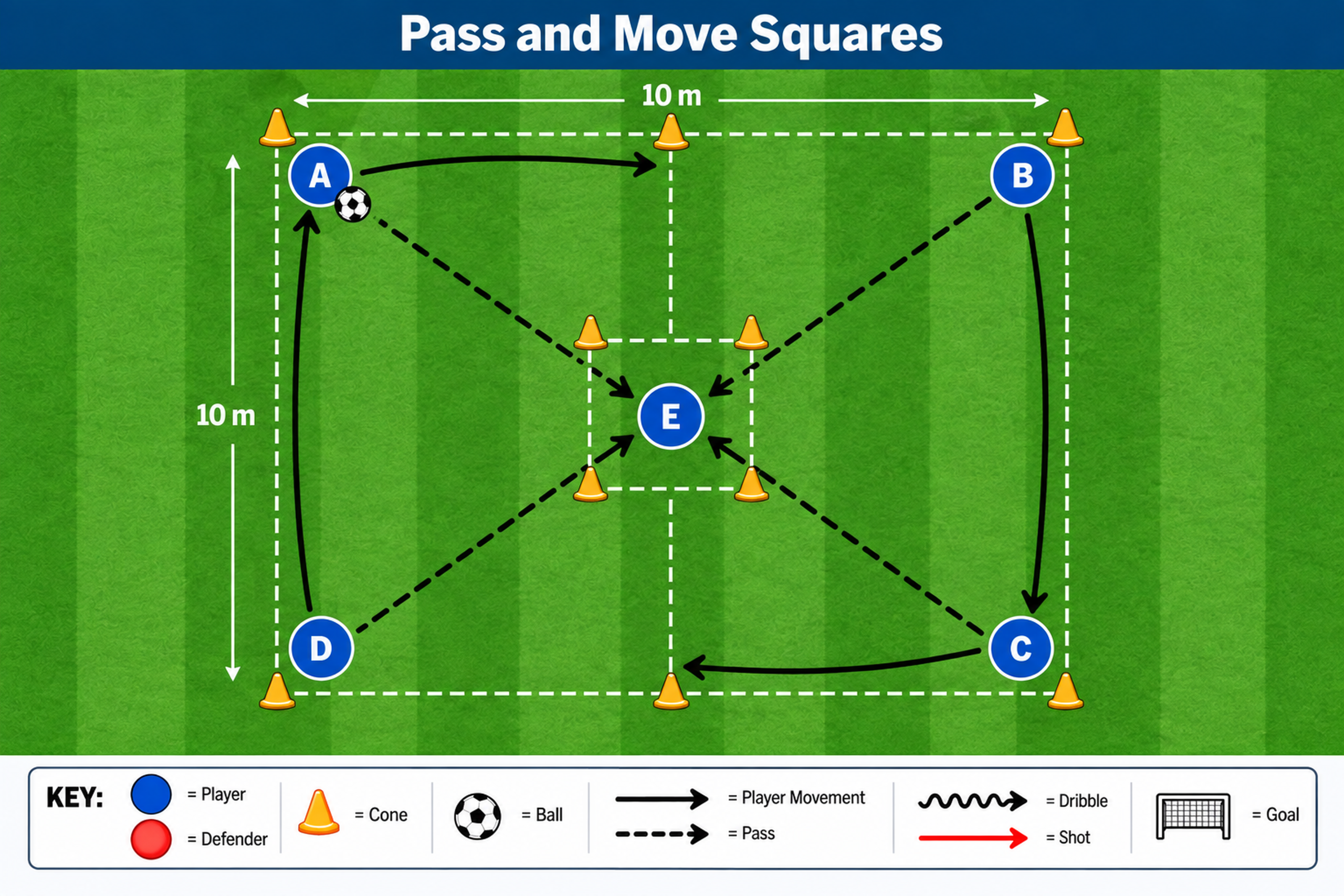
The diagram above shows the basic organization. A–D represent the four outside passing positions, while E represents the central receiving position. With 8–12 players, additional players are distributed behind the four outside positions rather than adding extra stations.
Age Group
Age: 8
Skill Level: Intermediate
Players
8–12 players
Ideal organization: 2–3 players at each outside station, with one player occupying the central receiving position at a time.
Duration
5–10 minutes
Run for approximately 2 minutes in each direction, with brief coaching interventions and a progression.
Equipment
- 1–2 soccer balls
- 8 cones
- Spare balls beside the starting station
- Jerseys/pinnies if needed
Area
10 × 10 yards
Mark a small 2 × 2-yard receiving square in the center with four cones.
For a less experienced group, increase the outside area to approximately 12 × 12 yards.
Skills Developed
- Short passing accuracy
- First touch
- Receiving with an open body position
- Passing and immediately moving to support
Setup
Create a 10 × 10-yard square using four outside cones. Mark a 2 × 2-yard receiving square in the middle.
Divide the players approximately evenly between the four outside stations. Place one player inside the central square. The remaining players wait at the outside stations, but because the ball continually travels around the activity, waiting periods should be short.
Place a ball with the first player at one outside station. Keep spare balls nearby so the drill can restart immediately if a ball leaves the area.
The outside players should be approximately 7 yards diagonally from the central receiver.
How to Run the Drill
- The first outside player, A, passes along the ground into E, who is inside the central square.
- Before receiving, E looks toward the next outside station. E uses the first touch to take the ball toward B, rather than stopping it directly underneath the body.
- E then passes to B.
- Immediately after passing, A runs into the central square and becomes the new receiver. E follows their pass and joins the back of B’s station.
- B now passes into A in the middle. A receives across the body toward C and passes to C.
- B moves into the central square, while A follows the pass to C.
- Continue the sequence around the square: A → E → B → new central receiver → C → D → A, with the passer entering the middle and the central player following their pass to the next outside station.
- Encourage a rhythm of pass → move → receive → first touch → pass. Players should not wait until the ball reaches the next station before beginning their rotation.
- Initially allow as many touches as required. Once the group establishes the pattern, encourage the central player to complete the action in two touches: one touch to receive toward the next player and one touch to pass.
- After approximately 2 minutes, reverse the direction so players practice receiving and passing from the opposite side.
If the sequence breaks down, quickly return a ball to an outside station and restart rather than stopping for a lengthy explanation.
Coaching Points
1. First touch toward the next pass: Watch whether the central player’s first touch prepares the next action. If the ball stops directly underneath them, encourage them to angle their receiving foot so the ball travels 1–2 yards toward the next outside player.
2. Receive side-on: Encourage the central player to open their hips before the ball arrives. They should be able to see both the passer and the player they intend to pass to.
3. Use appropriate passing weight: Passes into the middle should be firm enough to reach the receiver cleanly but not so hard that an eight-year-old struggles to control them.
4. Inside-of-the-foot technique: For short passes, look for the non-kicking foot beside the ball, ankle firm and the inside of the kicking foot contacting through the middle of the ball.
5. Move immediately after passing: Players should begin moving as soon as their pass leaves their foot. Correct players who remain watching their pass before moving.
6. Look before receiving: Encourage central players to briefly check the next outside station before the ball arrives. This introduces the habit of gathering information before receiving without making the drill tactically complicated.
Progression
Introduce a second ball on the opposite side of the square.
Both balls follow exactly the same passing and rotation pattern. Players must now look before moving into the middle and communicate so that the two sequences do not collide.
For a particularly capable group, require the outside players to play one-touch passes into the middle, while the central receiver remains limited to two touches.
Easier Variation
Increase the area to 12 × 12 yards and allow the central player to take three or more touches.
Instead of immediately rotating positions, let each central player receive and pass four times before changing. This removes the movement pattern temporarily and allows players who are struggling to concentrate specifically on first-touch technique.
Common Mistakes
First touch stops the ball: Players often receive directly underneath themselves. Place a cone approximately 1–2 yards toward the next station and challenge them to make their first touch travel toward it.
Players receive square-on: If the receiver faces only the passer, they need an extra touch to turn. Ask them to position themselves side-on before the pass arrives so they can see the next target.
Passes are too powerful: Eight-year-olds sometimes interpret “firm pass” as kicking as hard as possible. Demonstrate a controlled inside-foot pass that reaches the receiver without bouncing away.
Players forget to move after passing: Reinforce the simple cue “Pass and go.” The outside passer should be moving toward the middle immediately after releasing the ball.
Match Connection
The pattern recreates an important situation young players encounter throughout a game: receiving a pass, using the first touch to face a new direction, finding another teammate, and moving again after releasing the ball.
Rather than teaching players to receive, stop and then decide what to do, the drill begins developing the habit of preparing the next action with the first touch. This complements the emphasis in your reference material on first-touch control making subsequent decisions easier.
Drill 2: Triangle Passing to Small Goals
PURPOSE
This drill develops accurate short passing, a purposeful first touch, and movement immediately after releasing the ball. Players learn to receive with their body prepared for the next action and combine with teammates while moving toward goal.
For 8-year-olds, the emphasis should remain on repeated technical actions and simple decisions rather than complicated tactical instructions, consistent with the skill-focused approach in your reference material.
AGE GROUP
8
PLAYERS
8–12
DURATION
5–10 minutes
EQUIPMENT
- 2 small goals
- 6–8 cones
- 2–4 soccer balls
- Jerseys/bibs if needed
AREA
Approximately 15 × 12 yards per group.
For 10–12 players, create two identical triangles so players remain active rather than forming long lines.
SKILLS DEVELOPED
- Passing accuracy
- First touch
- Movement after passing
- Receiving with an open body
SETUP
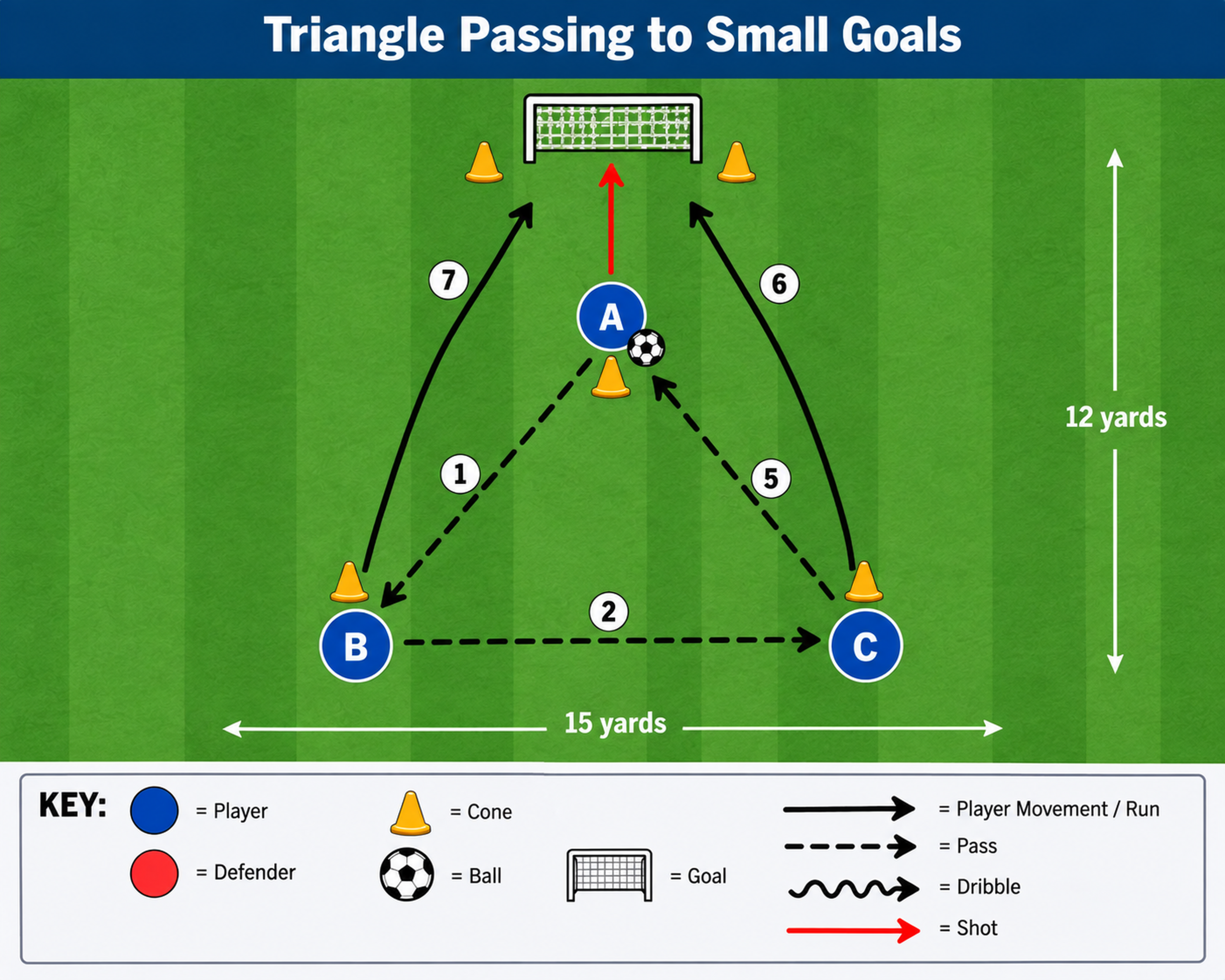
Create a triangle using three cones, approximately 5–6 yards apart. Position a small goal approximately 6–8 yards beyond the top cone.
Divide players between positions A, B and C. Place the balls at A. With a larger group, build a second triangle alongside the first and divide the players between the two areas.
HOW TO RUN
- A starts with the ball and passes along the ground to B.
- Immediately after passing, A makes a forward supporting run toward goal.
- B receives and uses the first touch to prepare the ball toward C.
- B passes to C and then moves forward to take A’s previous supporting position.
- C receives with an open body and uses the first touch to play forward.
- C passes into the path of the advancing A.
- A receives and finishes into the small goal.
- Players rotate A → B → C → A.
- The next ball begins immediately once the shooting area is clear.
- After approximately 2–3 minutes, reverse the triangle so players receive and pass from the opposite side.
Keep the sequence flowing rather than stopping after every repetition.
COACHING POINTS
- First touch forward: Guide the ball toward the next action instead of stopping it underneath the body.
- Open up before receiving: Approach slightly side-on so players can see both the passer and next teammate.
- Pass to the correct foot: Help the receiver play forward with fewer touches.
- Pass and move: Players should accelerate into their new position immediately after passing.
- Keep passes on the ground: Encourage firm, controlled inside-foot passes.
- Look before receiving: Players should identify their next pass before the ball arrives.
PROGRESSION
Make the final combination a one-two between C and A. C passes to A, immediately continues toward goal, and A returns the ball into C’s path for the finish.
For players who are succeeding consistently, limit B and C to two touches: one to control and one to pass.
EASIER VARIATION
Reduce the triangle to approximately 4–5 yards between cones and remove the shot. After receiving C’s pass, A simply controls the ball inside a small end zone.
Allow unlimited touches until players understand the movement pattern.
COMMON MISTAKES
- First touch stops the ball: Ask players to push their first touch gently toward the next target.
- Players watch their pass: Reinforce “pass, then move.”
- Receiving square-on: Encourage players to turn their hips so they can see the next destination.
- Passes are too powerful: Reduce the distance and emphasize accuracy before speed.
MATCH CONNECTION
The sequence recreates a common attacking situation: pass to a teammate, move into space, receive again farther up the field and attack goal. The first touch becomes a tool for continuing the attack rather than simply controlling the ball.
This also builds on the reference material’s emphasis on receiving the ball in a way that prepares the player’s next action, while using a different organization and movement pattern.


