

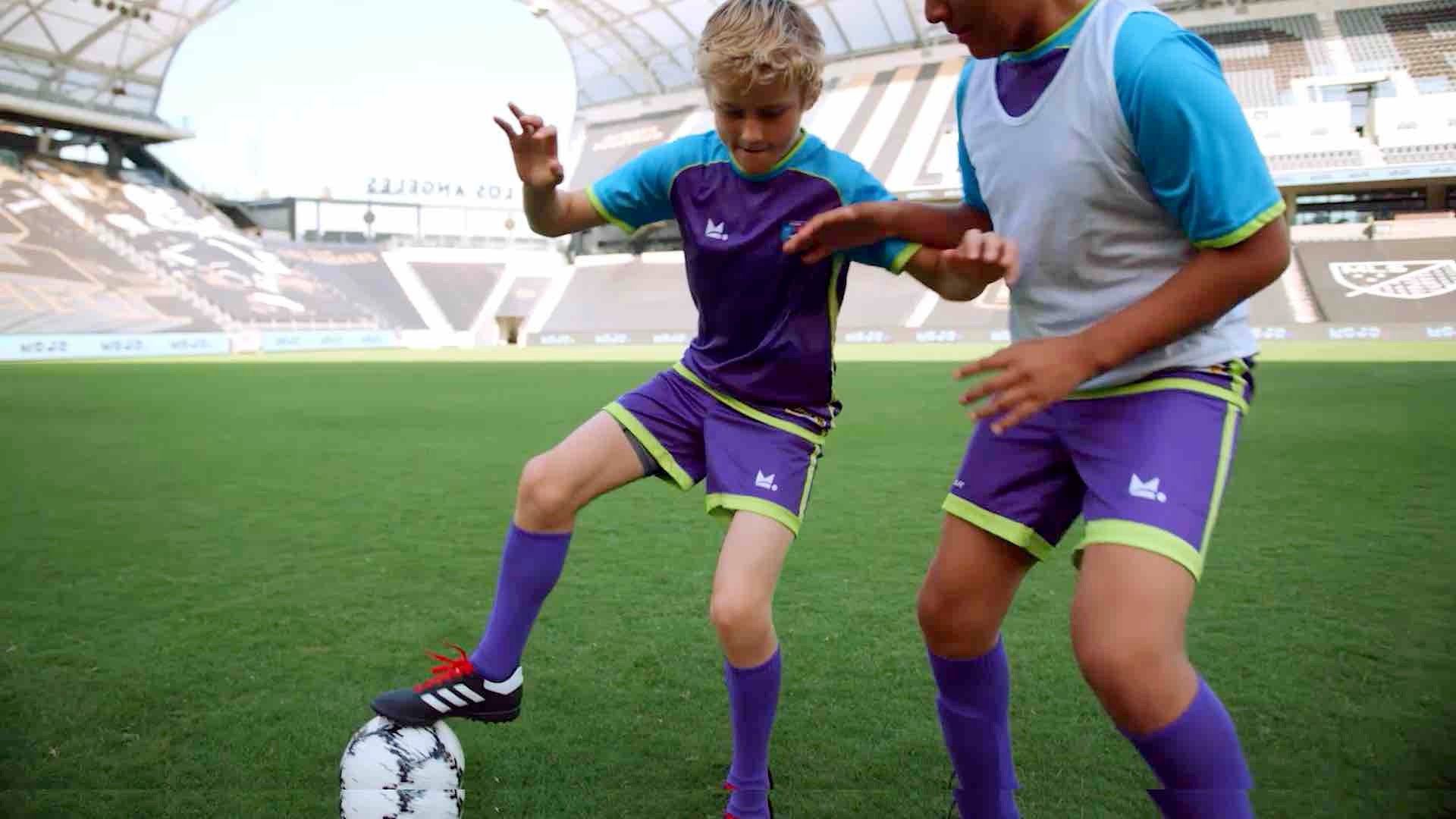
Every youth coach has seen it. A pass arrives at a nine-year-old’s feet, a defender breathes down their neck, and two seconds later the ball is gone. Often the player has the skill to keep it. What’s missing is a habit: check where the defender is, get the body between them and the ball, and wait for the right moment to escape. This soccer shielding drill for kids builds exactly that habit, and it does it with constant repetitions rather than long lines.
Shielding gets skipped in practice because it rarely looks exciting, yet it decides possession all over the field. The striker who receives with their back to goal, the winger pinned near the touchline, the midfielder who needs one more second for a teammate to arrive: all of them survive by shielding. Players who can’t do it either panic and boot the ball away or turn straight into the tackle.
Below you’ll find a complete session block for ages 8–11. It uses small three-player lanes, so everyone serves, attacks and defends in turn, and no one stands around for long. It gives players two clear ways to win: turn and dribble through a gate, or hold the ball and lay it back to the server. That choice matters, because in a game shielding is never the end goal; it buys time for the next good decision.
The Soccer Shielding Drill for Kids: Shield, Turn or Lay Off
PURPOSE: Players learn to receive a pass with a defender tight behind them, protect the ball with a side-on body position, and then choose the right exit: turn away from pressure when the defender over-commits, or keep the ball safe and lay it back to support. It mirrors the moment a forward or midfielder receives with their back to the opposition and has to keep possession for the team.
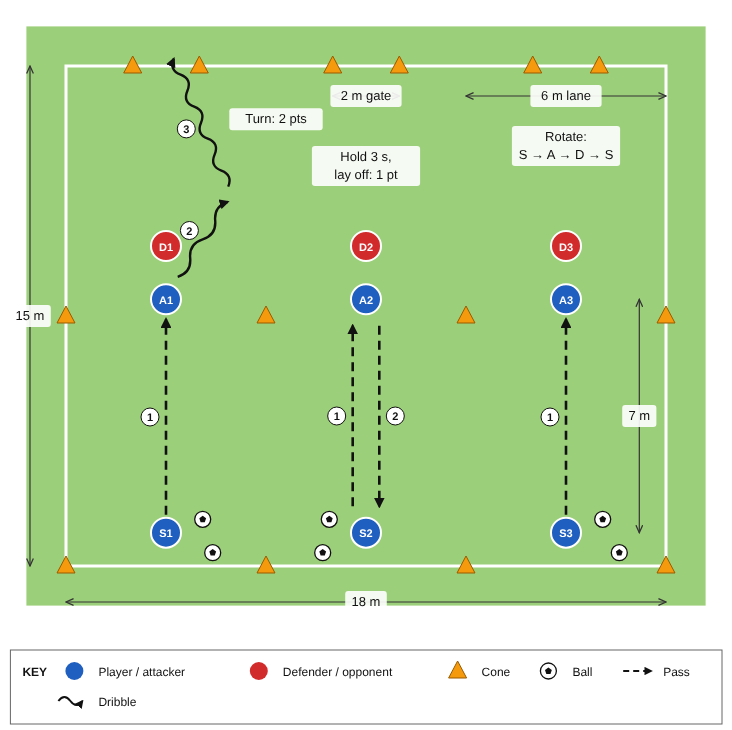
DIAGRAM:
AGE GROUP: 8–11 years, beginner to intermediate.
PLAYERS: 9 players are illustrated (three lanes of three). For 8 players, run two lanes of three and one lane of two, where the two players alternate A and D and the coach serves from between lanes. For 10 or 11 players, add a fourth player to one or two lanes; that extra player waits beside the server and joins the rotation (S → A → D → waiting → S). For 12 players, add a fourth lane and widen the area to 24 m.
DURATION: 10 minutes: two 4-minute blocks, a 1-minute water and coaching break, and about 1 minute to mix groups.
EQUIPMENT: 1 ball per lane plus 1 spare beside each server, 14 cones. No bibs needed, because roles change every repetition.
AREA: 18 m wide × 15 m long, split into three lanes of 6 m × 15 m.
SKILLS DEVELOPED:
- Shielding the ball under pressure
- Turning away from a defender
- Receiving with the back to pressure
- Decision making: turn or lay off
SETUP:
- Mark an 18 m × 15 m area. On the near end line, place cones at 0, 6, 12 and 18 m. Repeat the same four cones halfway up (7.5 m). This splits the area into three lanes, each 6 m wide.
- On the far end line, place only gate cones: a 2 m gate in the middle of each lane (two cones, 1 m either side of the lane’s center). Keep other cones off the far line so the gate is obvious. Dribbling over the far line outside the gate does not score.
- Server S stands in the middle of the lane, 1 m inside the near end line, with a ball at their feet and a spare ball beside them.
- Attacker A stands 7 m in front of S, facing S, with their back to the far gate.
- Defender D stands about 1.5 m behind A, between A and the gate. The gate is about 5.5 m behind D.
HOW TO RUN THE DRILL:
- S starts with the ball and plays a firm ground pass to A’s feet. D may not move until the pass is played.
- As the pass travels, D steps in tight behind A. A checks over a shoulder before the ball arrives, then receives it on the foot furthest from D.
- A shields. D may try to win the ball by stepping around A’s side, but may not push, hold, or kick through A’s legs from behind. If A pushes or holds, D gets 1 point; if D fouls, A gets 1 point. Either way the rep ends.
- A has two ways to score. Turn and dribble through the far gate: 2 points. Or keep the ball for three seconds (S counts “one, two, three” out loud) and then pass it back to S’s feet: 1 point.
- The repetition ends when A scores, when D wins the ball and stops it with the sole (1 point to D), or when the ball leaves the lane. Each repetition lasts no more than about 10 seconds.
- Rotate straight away: S becomes the attacker, A becomes the defender, and D jogs back to become the server. Whoever has the ball passes it to the new server. If it is loose, the new server plays the spare, and the loose ball is brought back as the new spare.
- Each player attacks every third repetition, roughly every 30–40 seconds. Players keep their own score for the block.
- After 4 minutes, stop all lanes, give the water break, and use it to show one coaching point. Then mix the groups so players face new opponents and run a second 4-minute block. Stop earlier if any lane gets too physical, and restart with the easier variation below.
COACHING POINTS:
- Look over your shoulder while the ball is traveling, so you know which side the defender is on before your first touch.
- Stand side-on: hips and shoulder between the defender and the ball, belly button pointing toward the sideline, not the server.
- Bend your knees and sit low, weight on the balls of your feet, so a bump doesn’t knock you off balance.
- Keep the ball on the foot furthest from the defender, about a small step away from your body, and move it with little sole rolls as the defender circles.
- Keep a bent arm low and relaxed for balance and to sense the defender. Never push or hold.
- When the defender leans hard to one side, roll the ball the other way and push it toward the gate with the outside of your foot. If they don’t commit, be patient: hold for three and lay it off.
PROGRESSION: Replace the single gate with two 2 m gates in the far corners of each lane. The attacker must read which gate the defender is guarding and turn toward the other one.
EASIER VARIATION: Make the defender a “shadow”: hands behind their back, walking pace only, and they can only block, not tackle. The server rolls the ball by hand for younger players. Widen the lanes to 8 m so turning is easier.
COMMON MISTAKES:
- Square to the defender, ball between the feet. The defender can reach it easily. Fix: call “sideline!” so players turn their belly button sideways and move the ball to the far foot.
- Standing tall and getting bumped off. Fix: “sit in a chair” cue; freeze the rep and show how a low stance holds its ground.
- Using hands to push the defender away. Fix: a push gives the defender 1 point (step 3); remind players the arm is for balance, not shoving.
- Turning into the defender’s side. Fix: ask “where is the defender’s weight?” and have the attacker go to the other side.
MATCH CONNECTION: Shielding shows up when a striker receives a pass into feet with a center back behind them, or a winger is trapped near the touchline. The lay-off mirrors playing back to a supporting midfielder; the turn mirrors spinning a defender who steps too tight.
How to Get More From This Drill
Let players discover what works in the first block. In the water break, ask one question: “When was turning the right choice?” Most will say: when the defender leaned to one side. That’s your coaching point for block two.
To build a full session on this theme, follow it with a turning practice from our post on reinventing the hook turn, then finish with a small-sided game where any player who shields and lays off successfully earns their team a bonus point.
FAQ
How do you shield the ball in soccer?
Get your body between the defender and the ball, stand side-on with your knees bent, and keep the ball on the foot furthest from the defender. Use small touches with the sole to move the ball away as the defender moves, and look for the moment to turn or pass.
Is shielding the ball a foul?
No. Under the Laws of the Game, a player may shield the ball by standing between an opponent and the ball, as long as the ball stays within playing distance and they don’t hold or push the opponent off with their arms or body. That’s why the drill rewards a low stance, not strong arms.
At what age should kids learn to shield the ball?
Most players can learn basic body position around ages 7–8 with a passive “shadow” defender. Shielding against real pressure suits players from about 8 or 9, once they can control a ground pass.
Want More Drills Like This?
If your players need more help keeping the ball under pressure, the Youth Soccer Dribbling Drills Book by Chest Dugger has a section on dribbling and shielding, alongside turns, feints and running with the ball, all set out drill by drill for busy coaches. If you coach the 8–12 age group in particular, Soccer Drills for Kids Ages 8-12 gives you ready-to-run drills pitched at exactly that level. And if you’d like a whole coaching library in one go, the Chest Dugger 6 Book Soccer Coaching Bundle includes the dribbling book along with drills, offense, soccer intelligence, shooting and mental toughness.
Set up three lanes at your next practice and watch how much calmer your players look when a pass arrives with a defender on their back.


