

Your midfielder looks up, sees the striker’s marker standing right on top of them, and passes sideways. This keeps happening to your team again and again. The problem usually isn’t the passing. It’s that only two players are involved in each attack: the passer and the receiver, and defenders can read that easily. A third man run drill changes that by bringing a third player into the move.
In a third man run, Player A plays into Player B, and Player C, who the defenders weren’t watching, runs past and receives the next pass from B. The defender has been looking at the ball, so the runner is often free. This drill teaches all three jobs at once: the firm pass in, the quick release from the middle player and, above all, the timing of the run.
The Pass, Release, Run drill below is built for players aged 13 to 16 who can already pass and receive with some control. Two lanes run side by side, each with four players and one defender, so there is almost no waiting.
Third Man Run Drill: Pass, Release, Run
Purpose: Teach players to combine in threes: A passes into B, B releases the ball quickly on the half-turn, and C times a run past a marker to receive in space. The runner learns to start moving as the first pass is played, not after it arrives. This is how teams get a runner behind a defender who is busy watching the ball.
- Age group: 13–16 (U14–U16), intermediate.
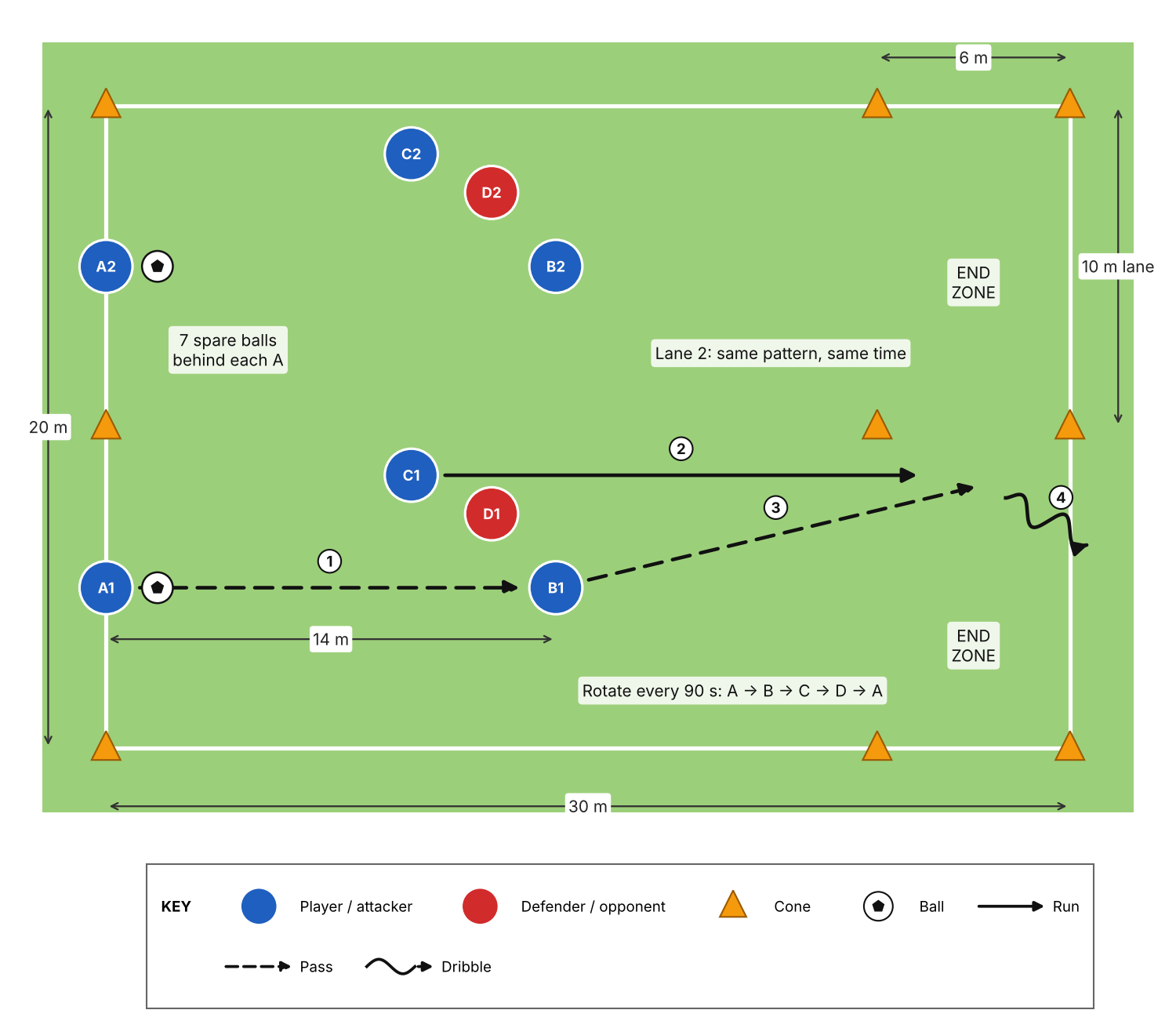
- Players: 8 shown: two lanes of 4, each with a passer (A), a link player (B), a runner (C) and a defender (D). With 9 or 10 players, add a second A to one or both lanes; the two A’s take turns to start the reps, and a 5-player lane rotates over five blocks (about 17 minutes in total). With 11, run two lanes of 4 and a third lane of 3 (A, B, C with no defender, as in the easier variation), and swap one player between the 3-player lane and a 4-player lane at each rotation. With 12, run three lanes of 4.
- Duration: 12–15 minutes: about a minute to explain, four 90-second blocks (one in each role) with 30 seconds between blocks to rotate and collect balls, then four 60-second blocks of the progression.
- Equipment: 9 cones for two lanes (3 more for each extra lane), 8 balls per lane, 1 red bib per lane for the defender.
- Area: 30 m x 20 m for two lanes, each lane 30 m long and 10 m wide, with a 6 m end zone at the far end.
- Skills developed: third man runs (timing a run off the ball), receiving on the half-turn and releasing quickly, passing firmly into a teammate’s feet, receiving on the run.
Setup
- Mark a 30 m x 20 m area with a cone on each corner. Play runs along the 30 m length, from the start line on the left to the end line on the right.
- Split the width into two 10 m lanes with one cone halfway along the start line and one halfway along the end line.
- Mark the end zone with three cones on a line 24 m from the start line (one on each side line and one where the lanes meet). The end zone is the last 6 m of each lane.
- In each lane, A stands on the start line in the middle of the lane with a ball at their feet. Put 7 spare balls just behind A.
- B stands in the middle of the lane, 14 m from A, side-on (half-turned), with hips open towards the side of the lane where C starts, so B can see A and the end zone.
- C starts 4–5 m nearer the start line than B and 1–2 m in from one side of the lane (about 9–10 m from the start line). Use the same side in both lanes.
- D, in a red bib, starts 2–3 m from C on C’s end-zone side (about 12 m from the start line), marking C.
How to Run the Drill
- Who starts: A starts with the ball. Both lanes start together when the coach calls “Go”, then run at their own pace.
- Pass in: A plays a firm ground pass to B’s feet. A may not pass directly to C.
- The run: C starts the run the moment the ball leaves A’s foot, going past D on the side away from B and on towards the end zone. C must not step into the end zone before B touches the ball.
- The defender: D may not move until A’s pass is played. Then D tries to stay with C and cut out the next pass. In the first four blocks, D moves at jogging pace and may intercept the ball but may not tackle.
- The release: B receives across the body with a first touch that goes forward, then passes with the second touch into C’s path so that the ball arrives in the end zone 1–2 m in front of C. B has a maximum of two touches.
- Finish the rep: C controls the ball in the end zone and dribbles over the end line, then leaves the ball just behind the end line.
- Scoring: A, B and C each score 1 point when C dribbles over the end line. D scores 1 point for an interception or for forcing the ball out of the lane. The rep doesn’t count if C entered the end zone before B touched the ball.
- Restart: C jogs back to the start spot along the edge of the lane and D jogs back to the marking spot. A plays the next ball as soon as both are in place, about every 12–15 seconds, so each lane gets about 6 reps per block.
- Rotation: after 90 seconds the coach calls “Rotate”. A moves to B, B to C, C to D and D to A. During the 30-second break, the new D and the new A collect the balls from behind the end line and dribble them back to the start line. After four blocks every player has played every role once.
- When to stop and reset: freeze the lane if C arrives early three reps in a row (standing in the end zone waiting) or if B keeps taking more than two touches. Walk the pattern through once at walking pace, then restart.
Coaching Points
- Go on the pass, not on the touch: C sets off the moment A strikes the ball. If C waits until B receives, D has time to recover.
- Run where D can’t see: C runs past the shoulder of D that is furthest from B, behind D’s back, while D is watching the ball go into B.
- Firm pass into B: A plants the standing foot beside the ball, locks the ankle and passes with the inside of the foot along the ground, hard enough that B can release it quickly.
- B’s body shape: B stays side-on, glances towards the end zone to see where C is heading before the ball arrives, and lets the ball run across the body so the first touch is with the back foot, already pointing forward.
- Weight the pass into space: B passes into the space 1–2 m ahead of C in the end zone, not at C’s feet, so C can keep running onto it.
Progression
D goes full speed and may tackle C in the end zone. B must play one touch, redirecting A’s pass forward with the inside of the back foot, and the end zone shrinks to 4 m by moving the three end-zone cones 2 m towards the end line. Points and rotation stay the same, with 60-second blocks.
Easier Variation
Take out D, so C only has to time the run to arrive in the end zone at the same moment as the ball. Shorten the lanes to 24 m with a 5 m end zone, move B to 10 m from A, start C 4 m behind B and 1–2 m in from one side, and let B take three touches.
Common Mistakes and How to Fix Them
- C runs too early and waits in the end zone. Remind C that the trigger is A’s pass, and start C further back (6–7 m behind B) so the run takes as long as the two passes.
- B’s pass goes to C’s feet or behind C. Ask B to glance before receiving and to aim for the space in front of the runner.
- B dribbles instead of releasing the ball. Count B’s touches out loud for a block (“touch… pass”) and give no point for a third touch.
Match Connection
A defensive midfielder plays into a forward who has dropped into the space between the lines. The forward receives on the half-turn and slides the ball through, and a winger or attacking midfielder who started running as the first pass was played gets in behind a full-back who was watching the ball. Pass, Release, Run rehearses that pass, release and run many times in a few minutes.
Third Man Run FAQ
What is a third man run in soccer?
It’s a run by a player who receives the ball from a teammate after a pass between two other players. A passes to B, and B passes on to C, who has been running into space. Because defenders tend to watch the first pass, the third player is often free.
How do you teach a third man run?
Start with a fixed pattern like this drill so players learn the timing: the runner goes as the first pass is played. Add a defender once the timing is right.
What age should players learn third man runs?
It makes the most sense from about 12 or 13, when players can read where teammates and defenders are.
Help Your Players Create More Chances
If you want more ideas for building attacks, the Chest Dugger Soccer Offense Book is about improving your players’ and your team’s attacking game. The Soccer Intelligence Book helps with the decisions behind it.
Coaching a whole season? The Chest Dugger 6 Book Soccer Coaching Bundle includes Soccer Offense and Soccer Intelligence along with Soccer Drills, Soccer Shooting Tips, Soccer Mental Toughness and Soccer Dribbling. Buying for a coach for Christmas? Order paperbacks by December 15.
For a simpler two-player pattern, try our give-and-go breakout soccer drill.
Free: Chest Dugger's 4-week soccer training sheet
Get the printable 4-week training plan straight to your inbox, plus new drills and coaching tips by email. Unsubscribe anytime.
Your email is only used for Abiprod soccer coaching emails. Privacy policy.


