PURPOSE
Teach players to pass, accelerate into space, and receive a return ball beyond a defender. The supporting player practises recognizing the run and delivering a well-weighted return pass. Two simultaneous small-sided games give everyone frequent opportunities to combine, move off the ball, and defend after losing possession.
AGE GROUP
All ages, provided players can make and receive short passes while moving. Group players by size and ability, and adjust the area as described below.
PLAYERS
Eight players illustrated: two separate games of 2v2.
| Available players | Organization |
|---|---|
| 8 | Two 2v2 games. |
| 9 | One 2v2 game; one 2v2 game with an attacking neutral. |
| 10 | Two 2v2 games, each with an attacking neutral. |
| 11 | One 3v3 game on an 18 × 12 m area; one 2v2 game with an attacking neutral. |
| 12 | Three 2v2 games. |
A neutral always supports the team in possession and can provide the return pass but cannot score. Change the neutral each round.
DURATION
8 minutes:
- 1 minute to explain and demonstrate.
- Four 75-second playing rounds.
- 20 seconds between rounds for recovery and brief feedback.
- 1 minute for a final review.
EQUIPMENT
- 8 cones: four per area.
- 2 balls: one per game.
- Bibs to distinguish the teams.
- For three games, use 12 cones and 3 balls.
- No goals required.
AREA
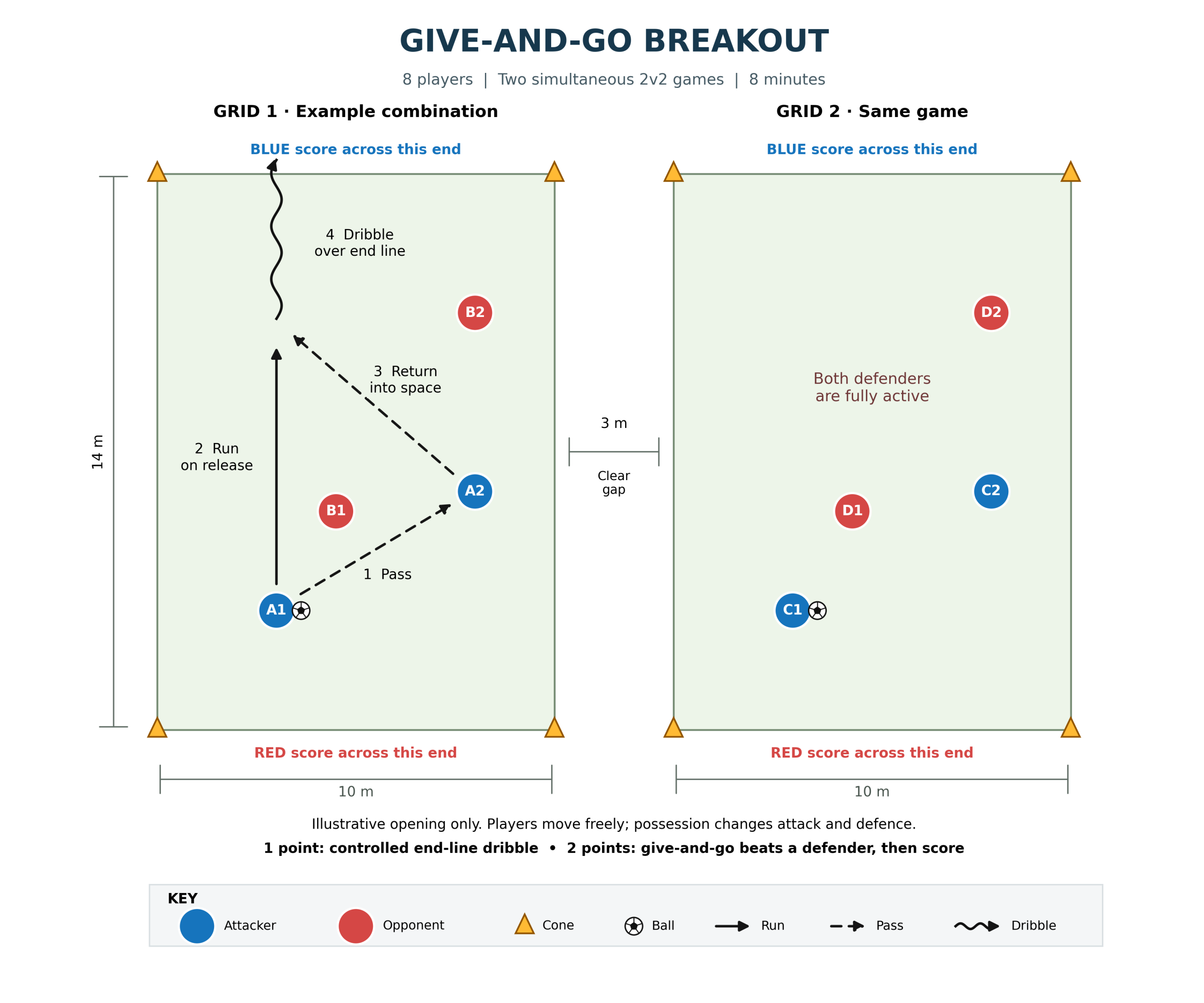
Each illustrated area measures 14 m long × 10 m wide.
Leave a 3 m clear gap between areas and at least 3 m of unobstructed run-off space beyond the scoring ends.
For younger players, start with 12 × 8 m. For older players who need more running space, use 18 × 12 m.
SKILLS DEVELOPED
- Give-and-go combinations.
- Running off the ball.
- Passing into a teammate’s path.
- Scanning and timing support.
SETUP
- Mark each rectangle with four corner cones. The two short boundaries are the scoring end lines.
- In Grid 1, A1 and A2 play against B1 and B2. In Grid 2, C1 and C2 play against D1 and D2.
- Blue attacks the top end of each diagram; red attacks the bottom end. These directions remain fixed throughout the round.
- For the illustrated opening, position A1 approximately 3 m from the bottom end and 3 m from the left side, with the ball. Position A2 6 m from the bottom end and 2 m from the right side.
- B1 starts centrally, approximately 5.5 m from the bottom end. B2 starts deeper, approximately 3.5 m from the top end and 2 m from the right side.
- Mirror those positions in Grid 2, with C1 starting on the ball.
These are starting positions, not fixed stations. Once play begins, everyone moves freely.
HOW TO RUN THE DRILL
- Start both games together. A1 and C1 begin in possession. Demonstrate the illustrated combination before allowing fully competitive play.
- Pass and move immediately. A1 passes diagonally to A2, then accelerates forward into space to the left of B1. The run begins as the pass leaves A1’s foot.
- Return into the runner’s path. A2 uses one or two touches to return the ball ahead of A1, beyond B1. In the example, A1 receives approximately 4 m from the attacking end line.
- Continue the attack. A1 receives in stride and attempts to dribble across the attacking end line. Both defenders remain active and can intercept, tackle, or recover. The illustrated sequence is an example, not a compulsory pattern: if the return route closes, keep possession and find another opening.
- Award points:
- 1 point: a player dribbles across the attacking end line with the ball under control.
- 2 points total: the same possession includes a successful give-and-go that takes the original passer beyond at least one defender toward the attacking end, followed by a controlled end-line dribble.
Award only one combination bonus per possession. Kicking the ball over the line and chasing it does not count as a controlled finish.
- React to turnovers. When red wins possession, red immediately attacks the opposite end. Blue becomes the defending team. No positional reset is needed.
- Restart quickly.
- After a score: the conceding team starts with the ball at its own defending end.
- After a sideline exit: the other team passes or dribbles in where the ball went out.
- After an end-line exit without a score: the team defending that end restarts there.
Opponents stand at least 3 m away until the restarting player first touches the ball.
- Keep everyone involved. Players alternate naturally between passing, supporting, attacking space, and defending. After round two, exchange one player from each opposing pair within each grid to create new partnerships. Rotate any neutral during the breaks.
- Stop only when useful. Pause immediately for unsafe contact or a stray ball entering another game. For repeated technical problems, use a scheduled break—or a brief freeze—to demonstrate one correction. After a coaching freeze, restart with the team that had possession.
Use ground passes, no slide tackles, and no offside rule.
COACHING POINTS
- Scan before receiving: check the defender and the space beyond them before the ball arrives.
- Offer a diagonal passing option: aim to support roughly 4–6 m away, outside the defender’s cover, rather than standing directly behind them.
- Pass to the available foot: plant the supporting foot beside the ball and use the inside of the kicking foot to deliver a firm ground pass away from pressure.
- Accelerate after release: take the first two running strides immediately after passing; do not stand watching the ball.
- Lead the runner: play the return approximately one or two strides ahead, allowing the teammate to receive without stopping.
- Read the defender: if the defender follows the runner or blocks the return, retain the ball and use the space that opens elsewhere.
PROGRESSION
Award the two-point score only when the return pass in the give-and-go is played first time. Keep all other rules unchanged.
Players should still choose another option when a first-time return is unavailable.
EASIER VARIATION
In each four-player grid, use two attackers, one attacking neutral, and one defender.
The neutral supports possession but cannot score. Allow two touches for the return pass. If the defender wins the ball, they earn a point and return it to the attackers for a fresh start.
Rotate the defender every 45 seconds, and change the neutral at the same time so everyone experiences each role.
COMMON MISTAKES
| Mistake | Practical correction |
|---|---|
| The passer stops to watch the pass. | Cue “pass, then two quick steps” to trigger immediate movement. |
| The return pass goes behind the runner. | Ask the supporting player to aim ahead of the runner’s leading foot. |
| Both attackers crowd the ball. | Restore a diagonal support distance of roughly 4–6 m. |
| Players force the return through a defender. | Remind them that the bonus rewards a successful decision; keep possession when the route is blocked. |
MATCH CONNECTION
This combination helps a midfielder escape a pressing opponent or a wide player pass inside and run into the channel. The key habit is immediate movement after passing: the player creates a new receiving angle while the defender’s attention shifts toward the ball.