Every coach has watched it happen. Your midfielder looks brilliant in the passing warm-up. Then Saturday comes, a pass arrives with an opponent closing from the side, and the ball bounces off a shin, stops dead under their feet, or gets taken straight back toward the pressure. Possession gone in one touch, because nobody ever trained their first touch under pressure.
The problem is rarely technique alone. What they are missing is a pressure-proof first touch: seeing where the defender is coming from before the ball arrives, then using that first contact to move the ball out of the defender’s path. Unopposed passing lines never ask that question.
The drill below works on this with a small, busy setup for 8 players aged 10–14. A defender presses from the side every time the ball is played in, and the receiver has three touches to escape and find a teammate at the far end. It is quick to explain and everyone works in every role.
First Touch Under Pressure Drill: Press Box Escape
DRILL NAME: Press Box Escape
PURPOSE: Players learn to read where pressure is coming from, take their first touch away from it, and play forward within three touches. In matches this is the difference between a midfielder who keeps the ball when an opponent closes in and one who gets caught in possession.
AGE GROUP: 10–14 years (intermediate)
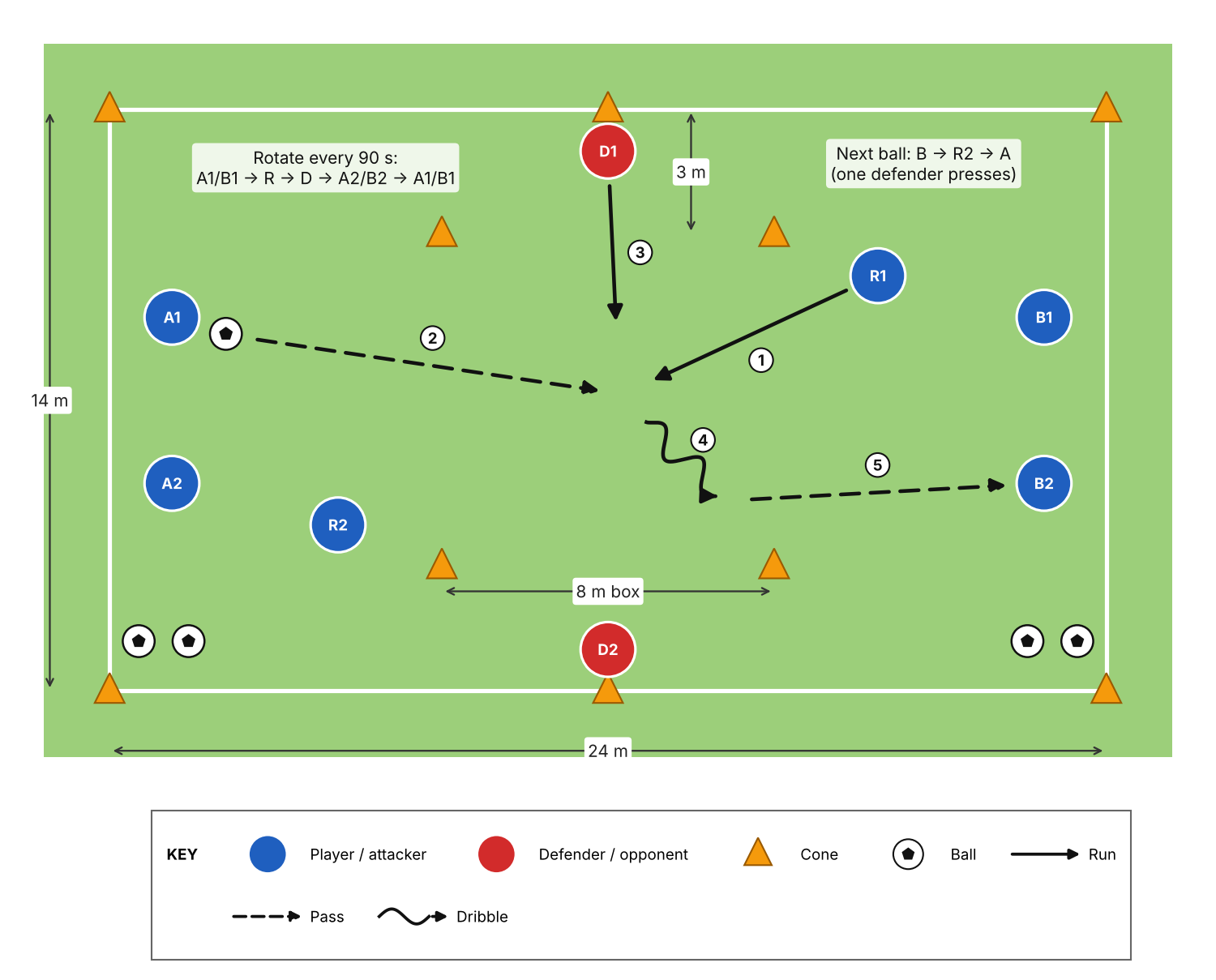
PLAYERS: 8 shown: 4 end players (A1, A2, B1, B2), 2 receivers (R1, R2) and 2 defenders (D1, D2). With 9–10, add a third end player at one or both ends. With 11–12, run two areas of 6 (one end player per end, who both receives and plays the next ball in). With 11, the area of 5 has one defender who presses every ball and swaps out every 60 seconds.
DURATION: 8–10 minutes (four 90-second blocks plus a short demo and quick changeovers)
EQUIPMENT: 5 balls (1 in play, 2 spares at each end), 10 cones, bibs for the two defenders (double everything for two areas with 11–12 players)
AREA: 24 m long (end line to end line) × 14 m wide, with an 8 m × 8 m box in the centre
SKILLS DEVELOPED:
- First touch under pressure (taking the ball away from a pressing defender)
- Checking toward the ball and arriving on the move
- Seeing the defender before the ball arrives
- Passing forward quickly after the escape touch
Setup
- Mark an area 24 m long × 14 m wide with a cone at each corner. The two 14 m lines are the end lines (A on the left, B on the right).
- Place 4 cones to make an 8 m × 8 m box in the exact centre. The box sits 8 m in from each end line and 3 m in from each long side.
- Put one defender cone at the middle of each long side line, 3 m from the box. D1 stands beside the top cone and D2 beside the bottom cone.
- A1 and A2 stand just inside the A end line, about 4 m apart. B1 and B2 do the same at the B end. A1 starts with the ball. Leave 2 spare balls at the bottom corner of each end.
- R1 waits just outside the B side of the box (near the top), because R1 always receives from the A end. R2 waits just outside the A side of the box (near the bottom), because R2 always receives from the B end.
How to Run the Drill
- Check in. R1 runs into the middle of the box toward the A end, timing the run to arrive as the end player with the ball is ready to pass (A1 on the first ball).
- Pass in. The A player with the ball plays a firm ground pass (about 10 m) to R1 in the box.
- Press. Before each pass, D1 gives a silent hand signal across the box: hand up means D1 goes, hand down means D2 goes. The moment the ball leaves A1’s foot, that defender sprints in to press; the other stays on their cone. R1 has to look to see which side the pressure is coming from. If both or neither go, replay the ball.
- Escape touch. R1’s first touch must move the ball away from the defender: if D1 comes from the top, the touch goes down and toward the B end; if D2 comes from the bottom, the touch goes up and toward the B end. R1 may carry the ball a step before passing.
- Play forward. R1 passes to either B player. R1 is allowed 3 touches in total, including the first touch, and alternates which B player gets the pass so both stay involved. R1 then leaves the box over the nearest long side and walks round to the waiting spot outside the B side, staying clear of the next passing lane.
- Reverse. The B player who receives R1’s pass controls it and plays the next ball straight back in to R2, who checks into the box toward the B end. Again one defender presses, R2 touches away from the pressure and passes to an A player within 3 touches, then returns to the waiting spot outside the A side.
- Scoring. The receiver scores 1 point when the pass reaches an end player within 3 touches without the defender touching the ball. The defender scores 1 point for touching the ball cleanly while on their feet, or forcing it out of the area. No slide tackles.
- Restarts. If the defender gets a touch or the ball leaves the area, the defender jogs back to their cone and the next ball is played from a spare at the end where the next rep starts (the ball always alternates: A end, then B end). The receiver fetches the loose ball, drops it on the spare pile at the nearest end, then returns to their waiting spot.
- Rotations. Play 90-second blocks. After each block: R1→D1 and R2→D2, D1→A2 and D2→B2, A2→A1 and B2→B1, and A1→R1 and B1→R2. After four blocks every player has played every role once. Each receiver gets roughly 8–10 balls per block.
- When to stop. Freeze play if receivers stand still in the box waiting for the ball, if defenders start sprinting in and crashing into the receiver, or if three reps in a row break down from poor passes in. Fix it with one quick demo, then restart from A1.
Coaching Points
- Look before the ball arrives. As the end player shapes to pass, take a quick glance at both defender cones. By the time the ball arrives you should already know which defender has left.
- Use the foot farther from the defender. If pressure comes from your left, cushion the ball with your right foot so your body stays between the defender and the ball.
- Move the ball 1–2 metres. The first touch should take the ball out of the defender’s running line, not stop it dead under your feet where they can reach it.
- Touch forward and away, not back toward the passer. That opens your body to the far end.
- Head up after the touch. Pick out the free end player and pass along the ground with the inside of the foot, ankle locked, on your second or third touch.
- Defenders: fast, then slow. Sprint the first few metres, then break down into short steps and a side-on stance about an arm’s length from the receiver. That makes the pressure realistic and keeps the drill safe.
Progression
Once most receivers score on more than half their balls, cut the limit to 2 touches (escape touch plus pass) and move both defender cones 1 m closer to the box, so the press arrives sooner.
Easier Variation
For younger or less experienced groups, fix the pressure side: D1 always presses R1 and D2 always presses R2, so the receiver knows which way to touch before the ball arrives. Allow 4 touches, and have defenders jog in and shadow rather than try to win the ball. Add the hand signal when players are succeeding.
Free: Chest Dugger's 4-week soccer training sheet
Get the printable 4-week training plan straight to your inbox, plus new drills and coaching tips by email. Unsubscribe anytime.
Your email is only used for Abiprod soccer coaching emails. Privacy policy.
Common Mistakes (and Quick Fixes)
- Receiver stands still in the box. Fix: start outside the box and check in when the end player looks up, so they arrive moving.
- First touch goes toward the pressure or dies under the feet. Fix: freeze and ask, “Where was the defender? Where is the empty grass?” Replay the ball slowly and let the receiver touch into that space.
- Defenders crash in at full speed. Fix: no point for any foul, and the coach calls “slow” as they get within 2 m.
- Passes in are slow or bouncing. Fix: end players strike through the middle of the ball, inside of the foot. A firm, flat pass is part of the challenge.
Match Connection
Think of a central midfielder receiving from a centre-back while an opponent closes from the side. A first touch away from pressure turns a likely turnover into a chance to play forward.
FAQ
How do you improve first touch under pressure in soccer?
Add a live defender to receiving practice so players must decide where their first touch goes. Unopposed passing builds clean technique, but reading pressure and moving the ball away from it only improves against a real opponent. Short, frequent repetitions beat long queues.
What age should players start receiving under pressure?
Light pressure can start once players control a firm ground pass reliably. Begin with the easier variation (fixed pressure side, shadowing defenders) and add choice and real tackling as confidence grows.
Which foot should you take your first touch with when a defender is close?
Usually the foot farther from the defender. It keeps your body between the opponent and the ball and moves the ball away from the press.
More Drills Like This
For more sessions that build players who stay calm on the ball, the 100 Soccer Drills Book gives you 100 ready-to-run drills across every part of the game. For the thinking side of receiving under pressure, try Soccer Intelligence. Coaching a team every week? The 6 Book Soccer Coaching Bundle puts six Chest Dugger coaching books in one bundle.
Want to keep working on control? Our u12 first touch soccer drills are a good unopposed starting point before you add the press.