

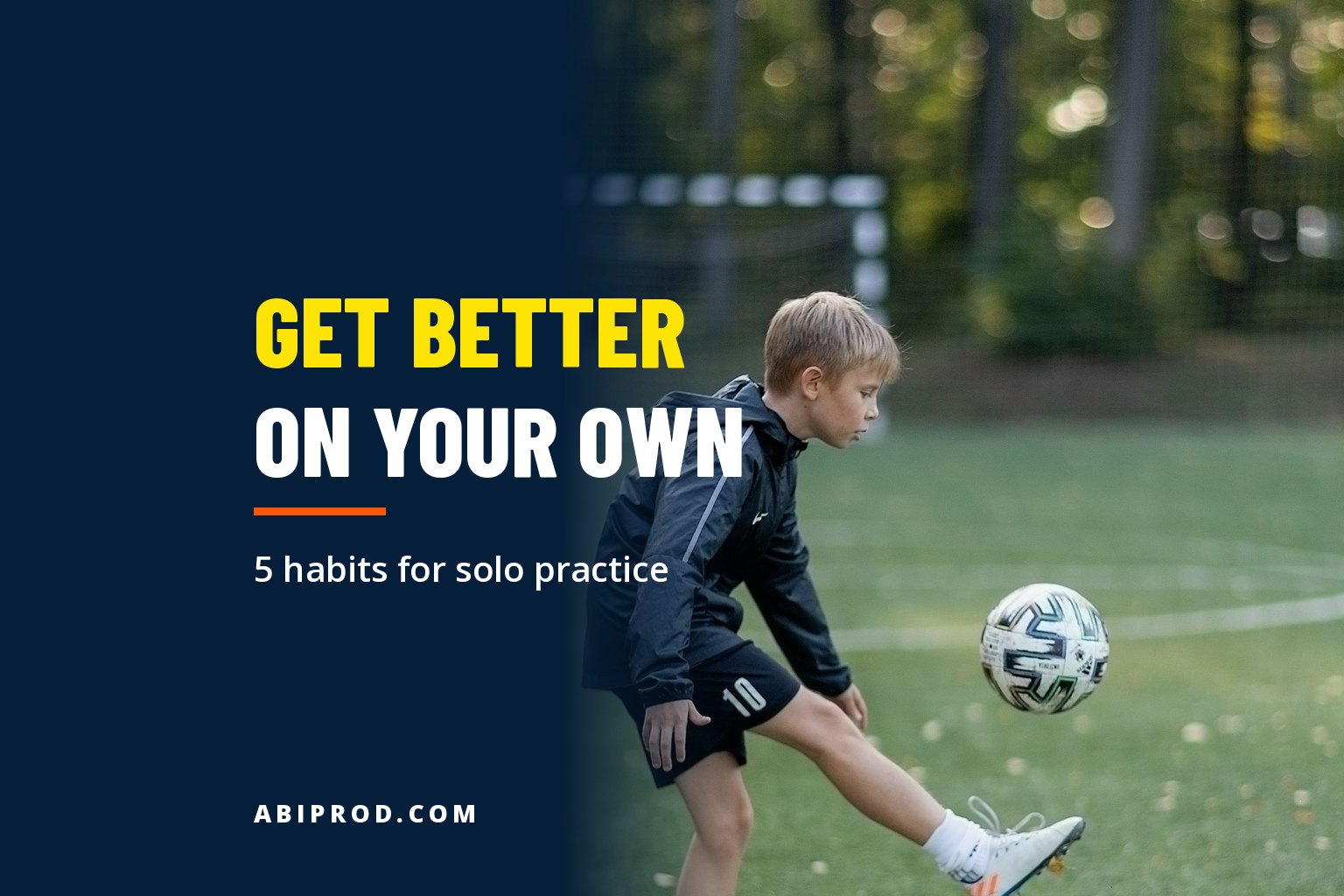
It is Saturday afternoon. There is no practice, no coach and no team, just you, a ball and a wall. You know you should be working on your game, but after ten minutes of juggling and a few shots, you are not sure what you are actually getting better at. If you have ever wondered how to get better at soccer on your own, this post is for you.
Most players who train alone already have plenty of drills. YouTube is full of them. What they are missing is a way of practicing that actually turns time alone into progress.
Fancy routines matter less than you think. What helps most is a few good habits: practicing little and often, working on what is hard and finding ways to coach yourself. Here are five of those habits, each with something you can try this week.
1. Little and often beats long and rare
Picture two players. One trains for two hours every Sunday and does nothing the rest of the week. The other spends fifteen minutes with a ball every day after school. By the end of the season, the second player is likely to have the better touch.
Skills like first touch and dribbling are habits, and habits are built by repetition spread over time. A short session every day keeps the ball familiar to your feet. A long session once a week mostly reminds you of what you forgot.
Try this: Pick a fixed time each day, such as straight after homework, and do fifteen minutes with the ball. Put it in your calendar or on a note on your door. Missing one day is fine. Missing two in a row is the warning sign.
2. Practice what feels awkward, not what feels good
When nobody is watching, it is tempting to do the things you are already good at. Your favorite move, shots with your strong foot, the juggling trick you have done a hundred times. It feels great, but it doesn’t change much.
Real improvement happens at the edge of what you can do. That is usually your weaker foot, receiving the ball on the half-turn (standing side-on, so you can turn the moment it arrives), or moving the ball quickly with small touches. These feel clumsy at first, and that clumsy feeling is the point. It means your body is learning something new.
Try this: Split every session into two halves. Spend the first half only on your weaker side or your weakest skill. Use the second half for something fun. You’ll still enjoy it, and the hard work is already done.
3. Be your own coach
The biggest thing you lose when you train alone is feedback. A coach would tell you that your standing foot is too far from the ball or that you are looking down every time you receive it. On your own, you need other ways to find out.
The easiest is your phone. Prop it against a bag, film a few minutes of your session and watch it back. You may be surprised by what you see. Something that felt smooth often looks slow, and a habit you never noticed, like always turning the same way, becomes obvious.
Numbers help too. Count how many passes in a row you can hit against the wall with your weaker foot, or how many touches it takes to dribble through a line of cones. Write the number down. Next week, try to beat it.
Try this: Choose one skill and one simple number to track for a month. For example: “Wall passes in a row with my left foot.” Test it every Friday and keep the scores in a notebook or on your phone.
4. Train your brain, not just your feet
Being better at soccer is not only about touch and fitness. It is also about knowing where to be and what to do next. You can work on that part of your game from the couch.
The trick is to watch games with a purpose. Instead of following the ball, pick one player who plays your position and watch only them for ten minutes. Notice where they stand when their team has the ball, how often they look over their shoulder before receiving it and what they do in the second after they lose it. We dig into this idea in our post Can Watching Soccer on TV Improve Your Own Game?
If you want to go deeper on decision-making, our Soccer Intelligence book explains how players can speed up their decisions on the field.
Try this: Next time you watch a match, pick one player in your position. Write down one thing they did that you could copy in your next game, then try it.
5. Add pressure so your skills survive real games
Solo training can feel slow. You practice for three weeks, and nothing seems different in games. This is the point where many players give up.
New skills often show up in practice long before they show up in matches. You might hit thirty wall passes in a row with your weaker foot at home, but in a game you still use your strong foot without thinking. That’s normal. Under pressure, players fall back on the skill they trust most, and that trust takes time.
Practice at home is calm, but games are not. So add a little pressure: a time limit, a rule that you must turn the moment the ball arrives, or a brother, sister or parent shouting “left!” or “right!” just before you receive it, so you have to react.
Try this: Set a 30-second timer and count how many clean wall passes you can make with your weaker foot. Try to beat your score every week. With the clock running, the skill starts to feel like part of a game, not just practice.
Free: Chest Dugger's 4-week soccer training sheet
Get the printable 4-week training plan straight to your inbox, plus new drills and coaching tips by email. Unsubscribe anytime.
Your email is only used for Abiprod soccer coaching emails. Privacy policy.
How to get better at soccer on your own: FAQ
How long should I practice soccer by myself each day?
For most young players, 15 to 30 minutes of focused practice a day is plenty. A short session done most days is worth more than one long session a week. Stop when your touch gets sloppy, because tired repetitions build sloppy habits.
What can I practice alone with just a ball and a wall?
Quite a lot. You can work on passing with both feet, first touch, receiving on the half-turn, volleys and one-touch passing. Move closer to the wall to make it faster and harder, or further away to work on longer passes.
Can you get good at soccer without a team?
You can build a lot of your technique, fitness and understanding on your own. You still need games to learn how to use those skills under pressure, so mix solo work with pickup games, small games like 3v3 with friends or your team’s matches whenever you can.
Your next step
Good habits matter more than any single drill, but it helps to have a plan for what to do in those fifteen minutes. No field nearby? Our Individual Soccer Drills at Home book gives you drills you can do on your own at home, so every fifteen-minute session has a purpose.


